
Does My Floor Need Sanding, Repairs, Restoration or Refinishing?

by Darren Admin
Most homeowners notice the same thing at some point: the wood floor that once looked rich and well cared for starts to look tired. There may be dull patches, light scratches, grey areas where the finish has worn away, loose boards, gaps, or parts of the floor that no longer feel solid underfoot. The immediate question is usually simple: does the floor need sanding, repairs, restoration or refinishing?
The honest answer is that the right treatment depends on what has actually failed. Sometimes the surface coating is the only problem. Sometimes the timber underneath has been exposed. Sometimes the floor is moving, damaged or missing sections. This guide explains how to read those signs so you can have a more useful conversation before booking any work.
What the Main Options Actually Mean
Before looking closely at your floor, it helps to separate the terms. They are often used interchangeably, but in practice they describe different levels of work.
Floor sanding is the process of removing the old surface finish and a very thin layer of the worn timber surface. It is used when the existing finish has failed, when scratches sit in the wood, or when the floor needs to be reset before a new finish is applied. In many projects, professional floor sanding is the foundation stage that allows the floor to be refinished properly.
Floor repairs are targeted fixes for specific problems. Loose boards, squeaks, broken edges, open gaps, damaged sections, water-marked boards and missing parquet blocks all fall into this category. Repairs may be localised, but they are often best carried out before sanding so the finished floor sits on a stable base.
Wood floor restoration is the broader description. It usually means the floor needs more than a cosmetic refresh. Restoration may include repairs, stabilisation, preparation, sanding and finishing. It is the right term when the floor has been neglected, altered, incorrectly repaired, heavily worn or affected by movement.
Floor refinishing focuses on the finish system. It may involve sanding and applying a new oil, lacquer or stain, but it can also describe lighter recoating where the existing finish is still sound. The important difference is that refinishing does not automatically solve structural movement, missing sections or deep damage.
A Quick Decision Table
| What you see | Most likely route | Why |
|---|---|---|
| Dull finish but no movement or bare wood | Refinishing | The coating may only need refreshing. |
| Bare timber, deep scratches or failed coating | Sanding and refinishing | The worn surface needs to be removed before a new finish is applied. |
| Loose boards, squeaks, gaps or damaged sections | Repairs before sanding | The floor needs to be stable before finishing. |
| Heavy wear, old repairs, movement and failed finish | Restoration | The floor needs a broader repair, sanding and finishing approach. |
| Loose or missing parquet blocks | Parquet repair/restoration | Individual blocks need stabilising before sanding. |
| Engineered wood with mild wear | Assessment first | The wear layer controls what is safe. |
How to Tell If Your Floor Needs Sanding
Sanding becomes the likely route when the finish has failed or the timber surface itself is marked. A floor may still look acceptable in low light, but if the protective coating has worn through, cleaning or polishing will not restore long-term protection.
Look for dull, cloudy or grey areas that do not improve after cleaning, worn patches where bare timber is exposed, clusters of scratches in hallways or around furniture, rough patches under bare feet, or uneven colour where some sections have absorbed dirt because the finish has broken down.
A simple fingernail test can help. Run a fingernail across a scratch. If the fingernail catches, the mark has usually gone beyond the surface coating and into the wood. A fresh coat over that scratch will not remove it. The scratch may become less obvious for a while, but it will still be present beneath the new finish.
Sanding is also normally required if you want a meaningful colour change. Stains, whitewashed effects and darker tones need a properly prepared surface. Applying colour over an uneven old coating usually creates patchy results.
When Repairs Should Come First
Some floors should not be sanded straight away. If a floor has loose boards, obvious movement, broken edges, unstable parquet blocks or gaps that indicate movement, those issues should be considered before the sanding work starts.
Sanding over movement can make a floor look better temporarily, but the finish may crack, separate or wear prematurely because the structure underneath is still unstable. A damaged board may also remain visible after finishing because the problem was never corrected.
Walk slowly across the room and listen. A few minor creaks in an older property are not unusual, but boards that visibly flex, lift at the edges or move independently need attention. Gaps that open and close seasonally may be normal timber movement, but wide gaps that collect dirt or expose the subfloor may need filling, slivers or other repair work.
Repair-first thinking is simple: the floor needs to be sound before it can be finished well. If loose sections, damaged boards or obvious gaps are present, wood floor repairs should be assessed before deciding on sanding or refinishing.
Restoration vs Refinishing: The Real Difference
Restoration and refinishing are often confused. The difference is the depth of the work. Refinishing improves or renews the surface coating. Restoration deals with the condition of the floor as a whole.
Restoration is usually needed where a floor is worn, unstable, damaged, stained or affected by old repairs. The job may involve replacing damaged sections, stabilising boards, repairing parquet, filling gaps where suitable, sanding back the surface and applying a new finish. This is why wood floor restoration is often the better description for older or neglected floors.
Refinishing is more suitable where the floor is fundamentally sound and the main problem is the protective coating. A floor with an intact finish that has simply dulled may not need a full restoration project. It may need cleaning, light abrasion and a new compatible coating.
The mistake is choosing refinishing because it sounds quicker, even when the floor has deeper problems. A lighter treatment can only protect what is already there. It cannot make loose boards stable, replace missing parquet blocks or remove deep stains below the surface.
Comparison: Sanding, Repairs, Restoration and Refinishing
| Option | Main purpose | Best suited to | Limitations |
|---|---|---|---|
| Sanding | Removes failed finish and worn surface | Deep scratches, bare wood, colour changes, failed coatings | Does not fix movement by itself |
| Repairs | Fixes local or structural problems | Loose boards, gaps, broken sections, missing parquet | May still need sanding/finishing to blend |
| Restoration | Brings a tired or damaged floor back to usable condition | Older, neglected, unstable or heavily worn floors | More involved than a light refresh |
| Refinishing | Renews the protective finish | Sound floors with surface-level wear | Cannot remove deep damage or fix structural issues |
Can a Floor Be Refinished Without Sanding?
Yes, but only under the right conditions. Refinishing without full sanding can be a good option where the existing coating is still bonded, the timber is not exposed and the wear is mainly cosmetic. It is often less disruptive than a full sanding project and can be useful as part of ongoing maintenance.
However, it has clear limits. It will not remove scratches that have cut into the wood. It will not remove black water staining, repair gaps, stabilise movement or deal with failed areas where the coating has completely worn away. If bare timber is visible, the exposed areas will usually absorb dirt and moisture differently from coated sections, so simply applying another coat rarely gives a consistent durable result.
A lighter floor refinishing approach is best seen as maintenance for a sound floor, not a rescue treatment for a damaged one.
What a Professional Assessment Should Cover
A useful assessment should not start with a fixed answer. It should look at the floor type, the finish condition, the stability of the floor, previous sanding history, repair needs and the result you want to achieve.
Solid boards, parquet and engineered wood all need different decisions. Solid timber usually allows more sanding than engineered flooring, but previous sanding history still matters. Engineered flooring depends on the thickness and condition of the top wear layer. Parquet needs additional checks because individual blocks can loosen or fail independently.
The assessment should also consider finish compatibility. A floor that has previously been oiled, lacquered, stained or contaminated with old residues may need particular preparation before a new system is applied. If colour change is required, the preparation standard becomes even more important.
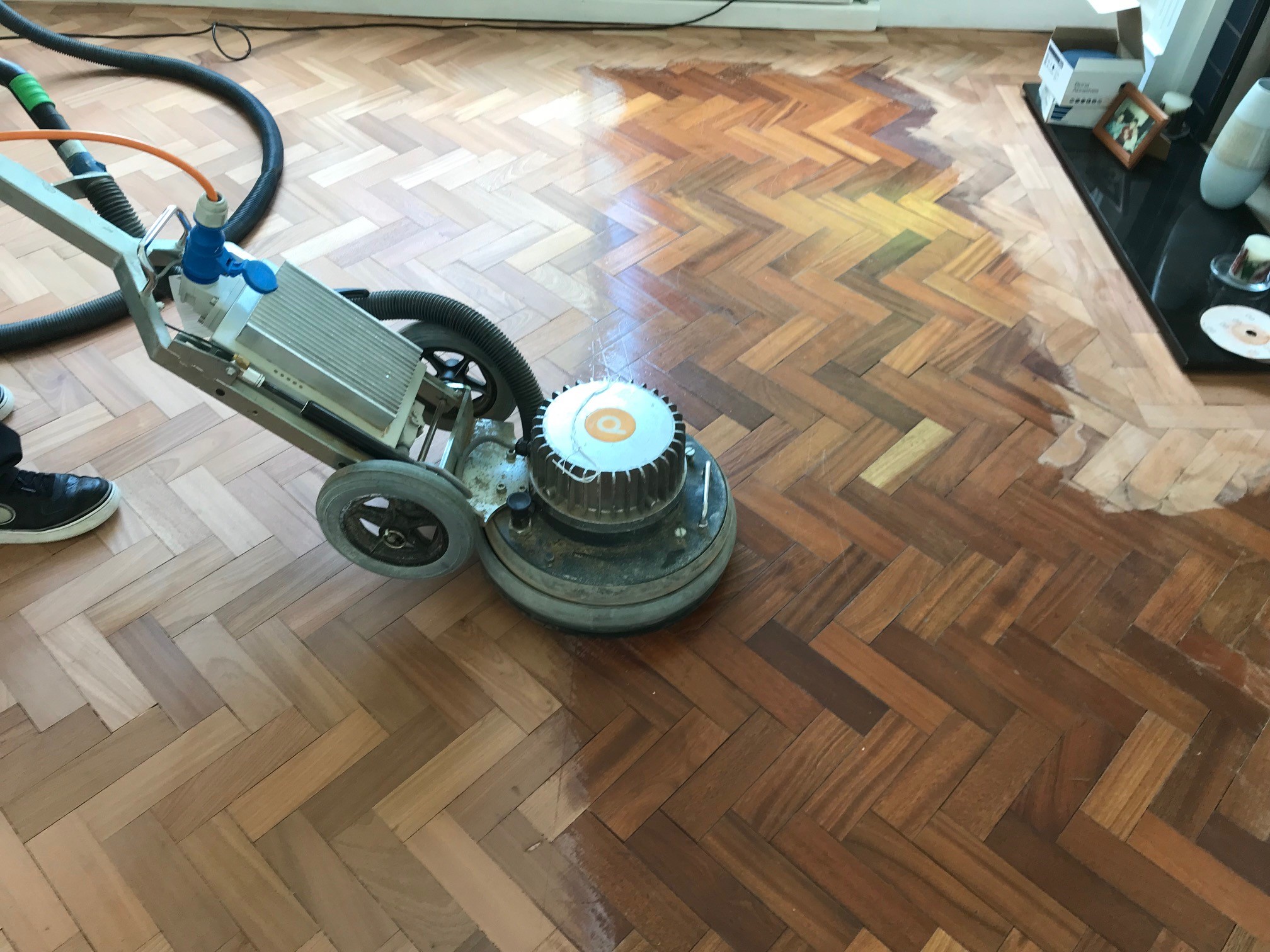
This is also where dust-controlled sanding should be discussed. Modern sanding equipment can significantly reduce airborne dust and help produce a cleaner working environment, but dust control is part of a wider professional process rather than a substitute for preparation or repairs.
Parquet Flooring Needs a Specialist Decision
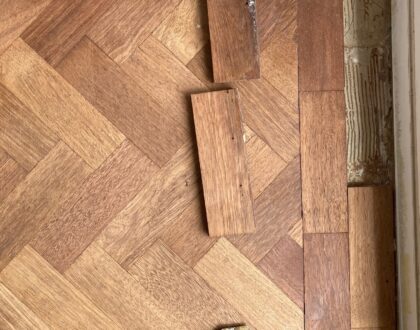
Parquet flooring deserves separate attention because it is not just a surface. It is a pattern made from many individual blocks. Those blocks can move, lift, shrink, break or lose adhesion independently of one another.
A parquet floor may look as if it only needs sanding, but if blocks are loose or missing, sanding first can make the problem worse. The edges of loose blocks can catch, the pattern can become uneven, and the final result may show movement that should have been dealt with beforehand.
Common parquet issues include loose blocks, failed adhesive, missing sections, gaps between blocks, uneven wear and old patch repairs. These should be assessed before sanding. In some cases, parquet floor sanding and restoration may involve re-securing blocks, replacing damaged sections, filling suitable gaps and then sanding and finishing once the floor is stable.
Matching replacement blocks is not always perfect because old timber changes colour with age and light exposure. A good repair aims for a sensible blend, not a false promise of invisible replacement in every case.
How Engineered Wood Floors Change the Decision
Engineered wood can sometimes be sanded, but the decision depends on the top wear layer. Unlike solid timber, engineered flooring has a real wood surface bonded to a core. If that surface is too thin, aggressive sanding can permanently damage the floor.
The first question is not simply whether the floor is worn, but whether enough usable wood remains. Previous sanding, deep scratches, edge damage and uneven boards all affect what is safe. In some cases a controlled light refinish is more realistic than full sanding. In other cases, if the wear layer is sufficient, sanding and refinishing may still be possible.
This is a good example of why on-site assessment matters. Two engineered floors can look similar but allow very different levels of correction.
Common Mistakes Homeowners Make
- The first common mistake is assuming every dull floor needs sanding. Some floors simply need maintenance refinishing if the coating is still sound.
- The second is choosing the cheapest light recoat when the floor has already failed. If bare timber, deep scratches or water staining are present, a surface coat is unlikely to solve the problem.
- The third is ignoring movement. Loose boards, lifting parquet blocks and unstable sections should be addressed before finishing. Otherwise the new finish can crack, wear or look uneven sooner than expected.
- The fourth is expecting repaired sections to disappear completely. Skilled repair and finishing can blend new timber well, but old floors have natural colour variation, grain differences and age-related changes.
- The fifth is leaving worn floors unprotected for too long. Once the finish has gone, the wood absorbs dirt and moisture more easily. At that point the work required can become more involved.
Practical Homeowner Checklist
Use this checklist before requesting advice. It will not replace an inspection, but it will help you describe the floor more accurately.
- Can you see bare wood where the finish has worn away?
- Do deeper scratches catch a fingernail?
- Does the floor move, bounce, squeak heavily or lift at the edges?
- Are any boards split, broken, water-marked or missing?
- Are gaps collecting dirt or exposing the subfloor?
- Are any parquet blocks loose, lifting or missing?
- Has the floor been sanded before, and if so, how many times?
- Is the goal a simple refresh, a colour change, or a complete restoration?
- Are there stains that appear to sit below the finish rather than on top of it?
Realistic Expectations Before Work Begins
A properly sanded, repaired and finished floor can make a dramatic difference, but it is still a real timber floor. Natural colour variation, old nail holes, historic repairs, reclaimed replacement boards and age-related markings may remain part of the character.
Some stains reduce significantly but do not disappear completely. Some gaps can be improved but not permanently eliminated because timber moves with humidity. Some replacement boards or parquet blocks can be blended well but may not be invisible. A trustworthy recommendation should explain these points before the work starts, not afterwards.
Good floor work is not just about making the floor look better on the day it is finished. It is about choosing a process that gives the floor the best chance of performing well over time.
Frequently Asked Questions
How often do wood floors need sanding and refinishing?
There is no single fixed interval. Some busy floors need attention sooner than quieter rooms. The better guide is the condition of the finish: if the coating has worn through, the floor feels rough, or scratches sit in the timber, sanding and refinishing may be needed.
Can all wood floors be restored?
Many wood floors can be restored, but not every floor can be returned to a perfect new appearance. Severe rot, very thin engineered wear layers, major structural problems or heavily damaged boards can limit what is realistic. A proper inspection should explain those limits clearly.
Is refinishing without sanding as good as sanding?
It can be a good maintenance option when the existing finish is sound and the wear is mild. It is not a substitute for sanding where bare timber, deep scratches, water staining or failed coatings are present.
What is the difference between refinishing and repairing?
Repairing fixes specific problems such as loose boards, gaps, squeaks or damaged sections. Refinishing renews the protective surface coating. A damaged floor often needs repairs first, followed by sanding or refinishing depending on condition.
Can parquet blocks be repaired before sanding?
Yes. Loose, damaged or missing parquet blocks are normally assessed before sanding. Where suitable material is available, blocks can often be re-secured or replaced, then blended during sanding and finishing.
Should I choose sanding or restoration?
If the main issue is a failed finish or surface wear, sanding and refinishing may be enough. If the floor also has movement, damage, missing sections or old poor repairs, restoration is usually the more accurate description.
Summary: Match the Treatment to the Floor
If the floor is sound but the finish is tired, refinishing may be enough. If the finish has failed and the wood is exposed, sanding and refinishing is usually the stronger option. If the floor has movement, missing sections, damaged boards or loose parquet blocks, repairs or restoration should be considered before finishing.
The safest approach is to diagnose the problem before choosing the treatment. A floor that only needs a lighter refinish should not be oversold a full restoration. A floor that needs repairs should not be rushed into sanding. The best result comes from matching the service to the actual condition of the floor.
Recommended Posts
How Does Dust-Controlled Floor Sanding Work?
08/08/2026
Is Parquet Floor Restoration Worth It?
06/08/2026
Can Missing Parquet Blocks Be Replaced?
06/08/2026
Testimonial Five
See more of our customer reviews at Checkatrade.com
YOU’RE IN GOOD HANDS






Contact our local carpet cleaners and local floor sanders near you to discover more about a full selection of floor restoration services.
Contact Us