
How To Fix Loose Floorboards Properly

by Darren Admin
You notice it the moment you walk across the room. A board dips slightly underfoot, then creaks as you step away. You go back and stand on it again. There is definite movement. The question most homeowners ask at this point is simple: is this normal, or does it need to be fixed?
Loose floorboards are among the most common floor repairs in older timber floors. Most loose boards can be repaired, and in many cases the problem is local rather than serious. The important point is that the repair should match the cause of the movement, not just the noise.
This article explains why floorboards become loose, how to recognise whether the issue is minor or more significant, and why proper assessment matters before any repair, sanding or finishing work is planned. It is a decision guide for homeowners, not a DIY instruction sheet.
Why Floorboards Become Loose
Floorboards rarely become loose overnight. The movement usually builds gradually, and by the time it becomes noticeable several factors may be involved. Timber naturally expands and contracts with changes in moisture and temperature. Over time, that repeated movement can loosen the fixings that hold a board in place.
Fixing failure is another common cause. Nails or screws that once held a floorboard firmly can work loose over many years, especially in older properties where the original floor has been in use for decades. Timber shrinkage can also create small gaps, allowing boards to shift slightly when walked on.
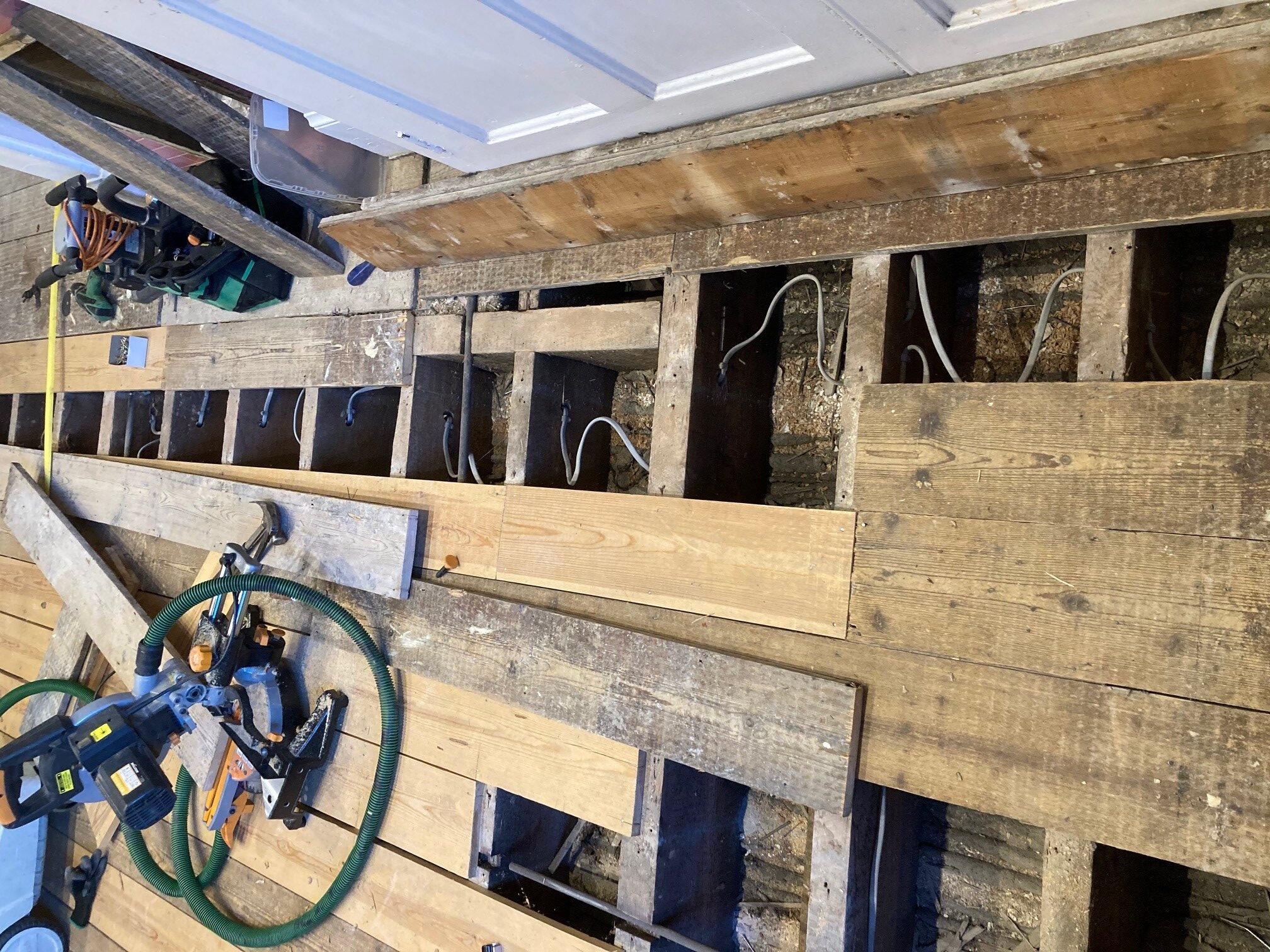
The issue is not always in the board itself. Subfloor movement, joist movement, water damage, previous poor repairs or wider structural settlement can all cause the boards above to move. This is why the best repair starts with understanding the cause rather than assuming every loose board needs the same treatment.
| Cause | Typical signs | Is repair usually possible? |
|---|---|---|
| Natural timber movement | Occasional creaks, small gaps, slight movement | Usually, if the floor is otherwise stable |
| Fixing failure | Boards lifting at edges or creaking underfoot | Usually, if the timber and joists are sound |
| Timber shrinkage | Gaps between boards, loose board ends | Usually, after checking movement |
| Subfloor movement | A springy or unstable section of floor | Often, but may need wider stabilisation |
| Water damage | Staining, warping, soft spots or distortion | Sometimes, depending on condition |
| Previous poor repairs | Failed patches, loose fixings, cracked filler | Usually, if the original issue can be corrected |
| Structural settlement | Wider movement, uneven levels or visible changes | Sometimes, but requires careful assessment |
When A Loose Floorboard Is A Minor Issue
Not every loose floorboard is a sign of serious trouble. A single board that creaks occasionally may simply have one fixing that has worked loose. If the surrounding floor feels stable, there are no soft spots, no damp staining and no wider movement, the issue is often local.
The same can apply to a board that moves only at one end. Many older floors have individual boards that have lifted slightly where fixings have loosened. The rest of the board and the surrounding timber may still be perfectly serviceable.
A minor issue is still worth addressing. A small squeak can become more noticeable, and a board that continues to move will keep wearing around its fixing points. Early repair is usually simpler than waiting until the movement grows.
When Loose Floorboards Suggest A Bigger Problem
Loose boards need a closer look when the movement is not confined to one or two boards. Several moving boards, a springy area of floor, visible unevenness or repeated repair failures can suggest that the cause lies beneath the surface.
Water damage also deserves caution. Boards that have swollen, cupped, softened or distorted may not simply need re-securing. The condition of the timber and the moisture source need to be understood first.
Wider movement does not automatically mean the floor is beyond repair. It means the repair may need to form part of broader wood floor restoration, especially where stabilisation, board replacement or subfloor attention is required before sanding or finishing.
Common Areas Where Floorboards Become Loose
Loose floorboards often appear in predictable places. Doorways and hallways take repeated foot traffic, so boards in these areas can work loose sooner than boards in low-use rooms. Thresholds are also vulnerable because boards may be shorter, cut around openings or affected by old alterations.
Fireplace and hearth areas are another common source of movement. Where a hearth has been removed or floor sections have been patched, the surrounding boards may no longer be supported or fixed in the same way as the original floor.
Boards near radiators, external doors and patio doors can also move because those areas are more exposed to changes in temperature and moisture. Previous repair areas are worth checking carefully, especially if filler has cracked, boards sit at slightly different heights or fixings have already failed once.
How A Professional Assesses Loose Floorboards
A proper repair begins with assessment. An experienced floor specialist will not only look at the board that moves; they will check whether the surrounding floor is stable, whether nearby boards are affected, whether there are signs of moisture, and whether previous repairs have failed.
The assessment should also consider what may be below the boards. Pipes, cables, joists, old notches, previous cuts and subfloor condition all influence what is safe and sensible. This is one reason loose board repairs should be approached carefully rather than treated as a one-size-fits-all task.
The main decision is whether the movement is local or structural. Local movement may need a targeted repair. Wider movement may need a more considered stabilisation plan before any sanding or finishing work is carried out.
Why The Cause Determines The Repair Method
There is no single correct way to repair a loose floorboard. A board that has simply worked loose from its fixings requires a different approach from a board affected by water damage, split timber or movement in the structure below.
Where the board is sound and the movement is local, the aim is usually to stabilise the board so it no longer moves underfoot. Where the timber is damaged, softened or split, local replacement may be more sensible. Where the subfloor is moving, fixing the board alone is unlikely to provide a lasting result.
This is why diagnosis matters. A superficial repair may quieten a board for a while, but if the cause is not dealt with, the movement can return. Proper repair means matching the solution to the reason the board became loose in the first place.
Loose Floorboards And Floor Sanding
Loose floorboards should usually be addressed before professional floor sanding begins. Sanding improves the surface of the floor, but it does not fix movement. If a board moves when the sanding machine passes over it, the result can be uneven, and the movement may reappear once the new finish is applied.
Loose boards can also cause problems for filler and finishing. Movement can crack filler, disturb edges and shorten the life of the finished surface. This is why repairs before sanding are normally considered part of good preparation rather than an optional extra.
Not every loose board needs replacing before sanding. In many cases, the existing board can be retained and stabilised. The key is that the floor should be made sound before it is sanded, not afterwards.
Loose Floorboards And Gap Problems
Loose boards and gaps often appear together. A board that moves can open a gap at the edge or end. A gap that has opened because of shrinkage can make a board feel less secure. Seasonal movement can add to the problem, especially in older floors.
Gap filling is most reliable when the floor is stable. If a board is moving, filler may crack or fall out because the gap is still changing. This is why loose boards should usually be assessed before wood floor gap filling is considered.
The right approach depends on whether the gap is mainly cosmetic, seasonal or linked to movement. Filling every gap without checking the floor can create more problems than it solves.
Loose Floorboards After Water Damage
Water damage can loosen floorboards in several ways. Timber may swell while wet, then shrink as it dries. Fixings may loosen, boards may cup or twist, and in more serious cases the timber can soften or decay.
A board that has moved after a leak should not be treated only as a loose fixing. The moisture history matters. The floor needs to be dry, the source of water should be resolved, and the affected timber should be checked before repairs are planned.
Some water-damaged wooden floors can be repaired and restored successfully. Others need local board replacement where the timber has lost strength. Sanding alone will not correct water-damaged timber that has become unstable.
Loose Boards In Older And Period Properties
Older properties often have original floorboards that have been in place for generations. Those boards may have aged, shrunk, been lifted for services, or been repaired more than once. Movement in a few boards is common and does not automatically mean the floor is failing.
The aim with period floors is usually to preserve as much original timber as possible while making the floor stable. New timber can sometimes be used where boards are too damaged to save, but exact colour and grain matching cannot be promised because old boards change with age and light exposure.
This is where experience matters. A repair that is too harsh for old timber can cause unnecessary damage, while doing too little may leave movement unresolved. The best approach balances stability, appearance and preservation of character.
Examples Of Loose Floorboard Situations
A Victorian hallway may have a few boards that creak near the doorway because the area takes heavy foot traffic. If the surrounding floor is sound, this may be a local repair before sanding.
A living room around an old fireplace may have boards that move because a hearth was removed and the floor was patched. In that case, the repair may involve stabilising the neighbouring boards and improving the patched section before the room is sanded.
A board near patio doors may move because historic moisture caused swelling and shrinkage. That area needs moisture and timber condition checked before assuming it only needs re-fixing.
A parquet floor with local movement may need loose blocks re-secured before sanding. If many blocks are loose, the issue may be wider adhesive failure rather than a small local defect.
Do Your Floorboards Need Repair?
Use this checklist as a practical starting point before arranging sanding or restoration work.
- The board moves when stepped on.
- Several boards creak in the same area.
- Gaps are increasing or collecting dirt.
- Previous repairs have failed or lifted.
- Boards feel uneven underfoot.
- Furniture rocks because the floor moves or dips.
- Water staining, cupping or soft timber is present.
- Movement is worse near doorways, fireplaces, radiators or external doors.
One sign on its own may be minor. Several signs together usually justify a proper assessment before sanding, filling or finishing work is planned.
Common Misconceptions About Loose Floorboards
Loose floorboards are common, but several assumptions lead to poor decisions.
- All old floors creak, so nothing needs doing. Some creaks are harmless, but movement should still be checked if it is getting worse.
- Sanding will fix loose boards. Sanding changes the surface, not the stability of the board.
- Gap filler fixes movement. Filler may fail if the board itself is still moving.
- Loose boards always mean replacement. Many loose boards can be stabilised and retained.
- A repair will be invisible. Good repairs can blend well, but exact invisibility cannot be promised on aged timber.
- A loose board is always structural. Some movement is local and straightforward, while other movement needs wider assessment.
Final Thoughts
Loose floorboards are familiar in many homes, especially older properties, and most cases can be resolved with the right approach. The important step is understanding why the floorboard is moving before deciding how it should be repaired.
A single loose board may be a minor local issue. Several moving boards, repeated repair failures, water damage or a springy section of floor may point to something more involved. The cause matters more than the creak itself.
If your floor has movement, squeaks, loose sections or failed previous repairs, a careful floor repairs assessment can identify whether a local repair, wider stabilisation, restoration or preparation before sanding is the most sensible route.
Frequently Asked Questions
Why do floorboards become loose?
Floorboards usually become loose because of natural timber movement, fixing failure, shrinkage, age, water damage, previous repairs or movement in the structure below. The cause matters because each situation needs a different level of repair.
Can loose floorboards be repaired?
Yes, many loose floorboards can be repaired, especially where the timber is sound and the movement is local. Boards that are rotten, badly split or affected by wider structural movement may need more involved work or local replacement.
Should loose floorboards be fixed before sanding?
Usually, yes. Sanding does not fix movement. Loose boards should normally be stabilised before sanding so the surface can be prepared properly and the new finish is not compromised by movement underneath.
Can water damage cause loose boards?
Yes. Water can cause boards to swell, shrink, cup, twist or soften. Once the floor is dry, the affected boards may remain loose or uneven. The timber condition should be assessed before sanding or finishing is carried out.
Do loose floorboards always mean replacement?
No. Many loose boards can be stabilised and retained. Replacement is usually considered when the board is rotten, badly damaged, too weak to hold properly, or part of a wider unstable section.
Can loose parquet blocks be repaired?
Often, yes. Loose parquet blocks can usually be re-secured if the blocks and subfloor are suitable. If many blocks are loose, the issue may be wider adhesive failure and should be assessed before sanding.
Recommended Posts
How Does Dust-Controlled Floor Sanding Work?
08/08/2026
Is Parquet Floor Restoration Worth It?
06/08/2026
Testimonial Five
See more of our customer reviews at Checkatrade.com
YOU’RE IN GOOD HANDS






Contact our local carpet cleaners and local floor sanders near you to discover more about a full selection of floor restoration services.
Contact Us