
Wood Floor Restoration vs Refinishing: What’s The Difference?

by Darren Admin
When a wooden floor starts to look tired, the words restoration and refinishing are often used as if they mean the same thing. In day-to-day conversation, that is understandable. Both can make an old floor look renewed, and both are usually less disruptive than pulling the floor up and starting again. But for a homeowner deciding what work is actually needed, the difference matters a great deal.
Refinishing is mainly a surface process. It renews the worn protective layer, refreshes the timber beneath it and applies a new finish. Restoration goes deeper. It considers the condition of the floor itself, including loose boards, gaps, missing sections, water damage, parquet blocks and earlier repairs that may need attention before sanding or finishing begins.
In many real projects the two overlap. A restoration project often ends with refinishing, because the repaired floor still needs a protective finish. The important question is not which term sounds better, but whether the problem is only in the surface finish or whether the floor beneath that finish also needs repair.
Why The Difference Matters
Choosing the wrong level of work can waste money and time. Refinishing a structurally damaged floor may improve the appearance for a short while but leave movement, gaps or loose sections unresolved. Full restoration, on the other hand, may be unnecessary if the floor is stable and only the surface finish has worn out.
A good assessment separates the problem into three areas: the finish, the timber and the structure. The finish is the protective coating on top. The timber is the wood itself. The structure is how securely the boards or blocks sit in the floor. Refinishing mainly deals with the first area. Restoration may deal with all three.
This is why the decision should be based on the condition of the floor rather than the age of the property or the wording on a quote. An older floor may only need refinishing. A newer floor with moisture damage or movement may need restoration.
What Does Wood Floor Refinishing Mean?
Floor refinishing is the process of renewing the visible surface of a wooden floor. The old finish, whether that is worn lacquer, tired oil, hardwax oil, stain or another coating, is removed or prepared. The exposed timber is then smoothed and a new protective finish is applied.
A common misconception is that refinishing is the same as sanding. Sanding is a stage within refinishing, but it is not the whole job. A refinishing project may involve room preparation, staged sanding or abrasion, surface assessment, dust removal, finish selection and application of the new coating.
Refinishing works well when the structure of the floor is sound. If the boards are stable, the floor feels solid underfoot and the problems are mainly cosmetic, refinishing can bring the floor back to a clean, protected condition without disturbing the structure.
A properly refinished floor is also easier to maintain than a worn, patchy floor. Once the protective layer has failed, dirt and moisture can reach the timber more easily. Covering that with polish may improve the look briefly, but it does not replace a failed finish. If the timber is sound, refinishing is often the honest and proportionate answer.
What Does Wood Floor Restoration Involve?
Wood floor restoration is broader. It starts with the visible condition of the floor, but it also asks why the floor is in that condition. A floor might look tired because the finish has worn out, or because loose boards, water damage, missing sections, large gaps or failed parquet adhesive are affecting the floor beneath the surface.
Restoration deals with those underlying issues first. Loose boards may need securing. Gaps may need assessing and filling where appropriate. Water-damaged timber may need drying, repair or replacement. Missing sections left by a removed hearth, old wall or pipe route may need rebuilding. Parquet blocks may need resetting or replacing before the surface can be sanded.
Only once the floor is stable should the surface work begin. That means restoration often includes sanding and refinishing, but those stages come after repair and preparation. Restoration is not just a more expensive word for refinishing. It is a wider process for floors where condition, stability or missing timber matters as much as appearance.
Where specific damage exists, floor repairs should normally be handled before sanding and finishing. That order matters because a new finish is only as reliable as the floor beneath it.
Refinishing And Restoration At A Glance
The table below gives a simple comparison. It is not a substitute for seeing the floor in person, but it helps explain the different roles.
| Question | Refinishing | Restoration |
|---|---|---|
| Main focus | The visible surface and protective finish | The floor as a whole, including condition and stability |
| Typical work | Sanding or abrasion and applying a new finish | Repairs, stabilisation, sanding and finishing |
| Best for | Dull, scratched or worn floors with stable boards | Floors with movement, gaps, damage or missing sections |
| Repairs included? | Usually only minor preparation | Often yes, depending on condition |
| Sanding involved? | Usually yes | Usually yes, after repairs are complete |
| Final finish involved? | Yes | Yes, as the final protective stage |
| Main limitation | Does not fix structural problems | May be more work than needed for a sound floor with surface wear only |
Both approaches have their place. The skill is choosing the right one for the floor in front of you. A floor can look worse than it is if the finish is badly worn. Equally, a floor can look acceptable from the doorway while hiding loose boards, old repairs or moisture damage.
Signs Your Floor Only Needs Refinishing
Many floors reach the point of needing refinishing because the protective finish has simply given up. The timber is still sound, but the coating that was protecting it has worn thin or become dull.
- The floor looks dull even after sensible cleaning.
- Scratches are mostly in the finish rather than deep into the timber.
- Traffic lanes have worn patches, but the boards feel stable.
- There is no obvious movement, springing or lifting underfoot.
- There are no missing boards, loose parquet blocks or major gaps.
- There is no active moisture problem or serious black staining.
When these conditions describe the floor, refinishing is often enough. The old surface is removed or prepared, the timber is smoothed, and a suitable finish is applied. If finish choice is the main question after sanding, a guide to choosing the right finish can help with that next decision.
There is also a lighter option in some cases. If the finish is only slightly worn and the floor has been maintained well, a maintenance coat or screen-and-recoat may be possible. Once the finish has worn through to bare timber, however, a proper refinish is usually the more realistic route.
Signs Your Floor Needs Restoration Instead
Restoration becomes more appropriate when the problem is not just the finish but the floor beneath it. These signs suggest that refinishing alone may not be enough.
- Boards are loose, lifting, creaking, springy or moving underfoot.
- Wide or uneven gaps collect dirt, allow draughts or suggest long-term movement.
- Water marks, black staining or discolouration suggest moisture has reached the timber.
- Parquet blocks have lifted, rattled, become uneven or gone missing.
- A hearth, wall removal or building alteration has left a missing section of flooring.
- Previous repairs stand out, have cracked, sit proud of the surface or use poorly matched timber.
- The floor feels unstable, uneven or soft in places.
Each of these issues affects the condition of the floor and should be addressed before finishing. Sanding a loose board will not secure it. Sanding over a gap will not make the gap stable. Sanding water-damaged timber will not remove the cause of the damage. Restoration tackles the cause before the final finish is applied.
Why Sanding Alone Will Not Solve Structural Problems
Floor sanding is central to both refinishing and restoration, which is one reason the terms are often confused. In a refinishing job, sanding removes the old finish and prepares the timber. In a restoration job, sanding does the same surface preparation, but only after repairs and stabilisation have been dealt with.
Sanding is excellent at transforming the surface of a floor. It can remove worn finish, level minor surface variation and reveal clean timber. What sanding cannot do is refix a loose board, replace a missing parquet block, close a moving gap or solve moisture trapped beneath the floor.
If structural issues are present, sanding first is the wrong order. Professional floor sanding should be part of a planned sequence, not a shortcut past repairs. When repairs are needed first, that advice protects the finished result as well as the budget.
Where Floor Repairs Fit In
Repairs often sit between refinishing and full restoration. Small local repairs may be needed before a refinish. Larger repairs may form part of a complete restoration project.
Common examples include securing loose boards, replacing damaged boards, rebuilding missing sections, repairing parquet blocks, dealing with appropriate gap filling and stabilising areas that move. These decisions should be made before sanding and finishing, not after the new finish has already been applied.
A useful rule is this: if the defect affects how the floor performs underfoot, it is probably a repair or restoration issue. If the defect mainly affects how the surface looks and the floor is stable, it may be a refinishing issue.
Restoration vs Refinishing For Water-Damaged Floors
Water-damaged wooden floors need careful judgement. A light watermark sitting near the surface may improve during sanding and refinishing. Deeper black staining, cupping, raised boards, softness or an ongoing moisture source usually points towards restoration or repair first.
The floor must be dry, stable and free from the source of moisture before sanding or finishing. If the moisture problem has not been resolved, a new finish can fail quickly. Some water-damaged boards can be saved. Some need local replacement. Some may be too damaged to restore sensibly.
This is why water-damaged wooden floors should be assessed as a condition issue rather than treated as a simple cosmetic mark.
Restoration vs Refinishing For Older Floorboards
Older floorboards often have character, movement, gaps, old repairs and colour variation. None of those automatically means the floor needs replacing or even full restoration.
If the boards are stable and the problem is mainly a worn finish, refinishing may be enough. If the floorboards are loose, split, missing, badly patched or affected by damp, restoration is usually more appropriate.
A restored old floor should still look like an old floor. The aim is not to make period boards look like factory-new timber. The aim is to make the floor sound, usable, clean and well protected while preserving as much original character as possible.
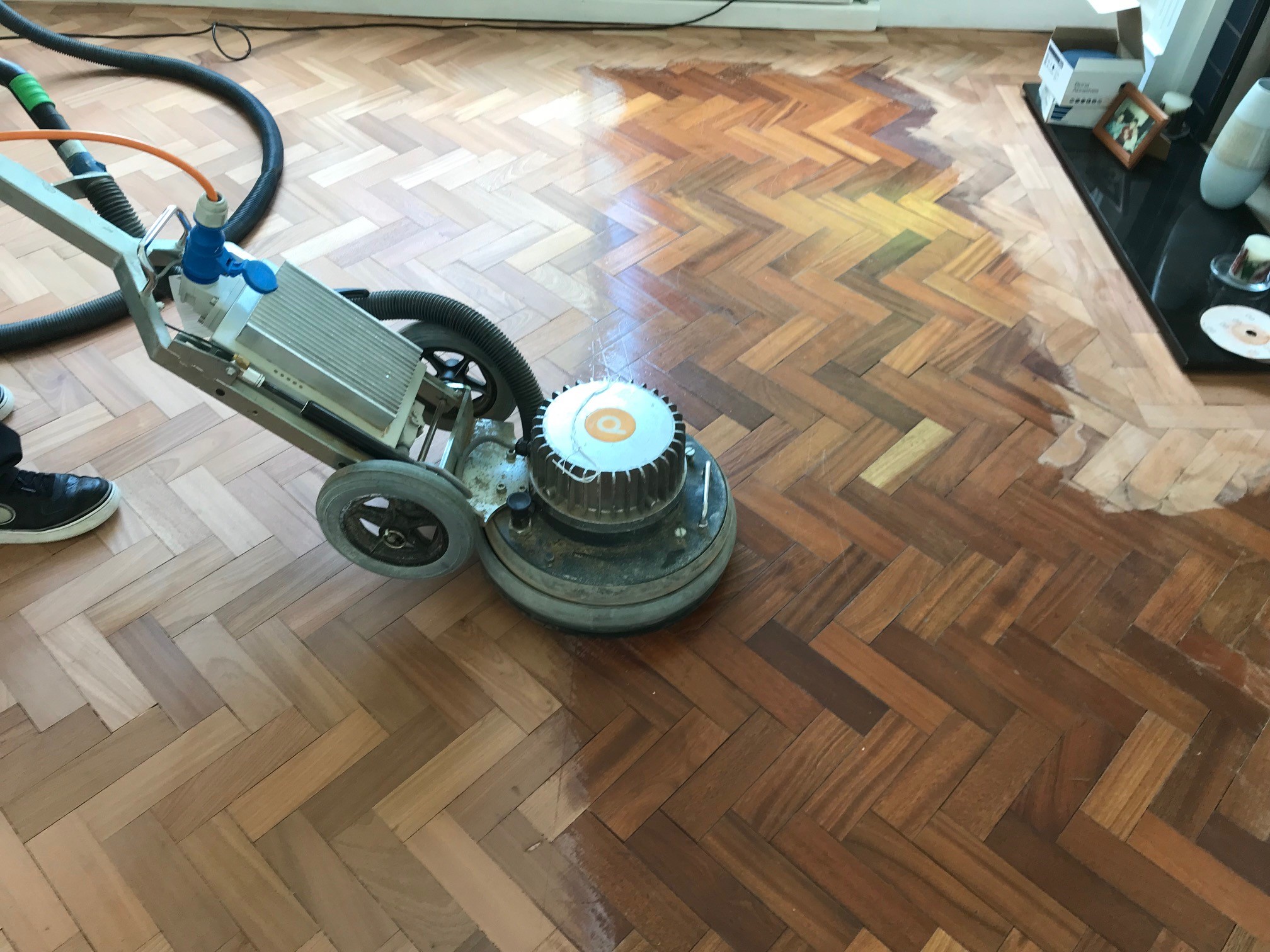
Restoration vs Refinishing For Parquet Floors
Parquet floors are different because they are made from individual blocks. A parquet floor can look reasonable from a distance while some blocks are loose, hollow-sounding, uneven or missing.
If the blocks are stable and the finish is simply worn, refinishing may be suitable. If blocks are loose, missing, moving or affected by failed adhesive, parquet floor restoration is the better description of the work because the pattern needs to be repaired and stabilised before sanding.
Pattern preservation matters. Sanding unstable parquet before repair can disturb blocks and make the final result worse. Repairs should come first, then sanding and finishing as a complete surface.
Can A Floor Need Both Restoration And Refinishing?
Yes. Many restoration projects include refinishing as the final stage. Restoration deals with repairs, stabilisation, missing timber and preparation. Refinishing then provides the final sealed surface once the floor is sound.
This is an important distinction because restoration and refinishing are not always separate choices. A floor with loose boards and a worn finish may need both: repairs first, then sanding and finishing. A floor with no movement and only surface wear may only need refinishing.
Can Refinishing Avoid Full Restoration?
Sometimes, yes. If the timber is stable and the finish has simply worn, refinishing can avoid unnecessary repair work. That is why a proper assessment should not automatically recommend the heaviest possible treatment.
However, refinishing should not be used to cover structural problems. A cheaper surface fix can become more expensive later if loose boards, water damage, failed adhesive or missing sections are ignored. Good advice means choosing the appropriate level of work, not always the biggest job.
Can Restoration Avoid Full Replacement?
Often, restoration is considered when a homeowner thinks replacement may be the only option. In many cases, original boards, parquet, period timber and repaired sections can be saved and brought back into use.
Replacement may still be necessary if timber is rotten, severely damaged, structurally unstable, too thin from previous sanding or affected by moisture beyond practical repair. The honest answer depends on the remaining timber, the repair options and whether the finished floor will be durable.
Cost And Disruption: Which Is Bigger?
Refinishing is usually less involved when the floor is stable because the work is mainly surface preparation and finishing. Restoration is usually more involved because repairs, stabilisation, matching timber or patching may be needed before sanding and finishing.
That does not mean one option is always better value than the other. Refinishing a floor that really needs repair can be false economy. Full restoration on a floor that only needs a new finish can be unnecessary. The cost and disruption depend on room size, floor condition, repair requirements, finish system and drying or curing needs.
The practical question is not which service sounds cheaper. It is which level of work will solve the problem properly.
A Practical Decision Table
| What You Notice | More Likely To Need | Why |
|---|---|---|
| Dull finish but stable boards | Refinishing | The issue is probably in the protective coating |
| Light surface scratches only | Refinishing or maintenance | The timber may still be sound |
| Bare timber in traffic lanes | Refinishing | The finish has worn through and needs renewing |
| Loose or creaking boards | Repairs or restoration | Movement should be addressed before sanding |
| Large gaps | Repair assessment or restoration | The floor may have movement, shrinkage or previous repair issues |
| Water marks or black stains | Restoration assessment | Moisture may have affected the timber |
| Missing boards or patches | Restoration | Sections may need rebuilding before sanding |
| Loose parquet blocks | Parquet restoration | Blocks need securing before sanding |
| Cupped or uneven boards | Restoration assessment | Moisture or movement may be involved |
| Previous poor repairs | Restoration | Old repairs may need correcting before finishing |
| Floor sanded many times | Careful assessment | Remaining timber thickness matters |
| Soft or rotten timber | Repair, restoration or replacement | Unsound timber may not be suitable for refinishing alone |
Common Misconceptions
Most confusion comes from assuming the surface appearance tells the whole story. It does not. These are the most common misunderstandings.
- Refinishing and restoration are the same thing.
- Sanding fixes every problem in a wooden floor.
- A shiny new finish will hide structural movement.
- Old floors always need full restoration.
- A floor that looks acceptable cannot have hidden problems.
- Restoration means making the floor look brand new.
- Every stain will sand out completely.
- Every repair can be made invisible.
- Replacement is always the only option for damaged original floors.
A more realistic view is that wooden floors sit on a spectrum. Some need maintenance. Some need refinishing. Some need repairs and restoration. A few need replacement. The floor itself decides the right answer.
Questions To Ask Before Deciding
Before choosing between refinishing and restoration, ask practical questions about the condition of the floor rather than just how it looks.
- Does the floor move, creak, spring or dip underfoot?
- Are there missing boards, patches or signs of previous building alterations?
- Are there water marks, black stains or soft areas?
- Is the timber exposed, or is the floor just dull?
- Are parquet blocks loose, rattling or uneven?
- Has the floor been sanded before?
- Are previous repairs failing or standing out?
- Is the damage localised or spread across the room?
- Do you want to preserve the original floor if possible?
- Are you expecting a perfect new-floor look or a properly restored character floor?
How A Professional Assessment Helps
The most reliable way to decide between refinishing and restoration is to have the floor assessed properly. A specialist will look at the finish, timber condition, board movement, moisture signs, previous sanding history, remaining timber thickness, repair needs and floor type.
Honest advice may steer a homeowner towards the lighter option. A sound floor with worn finish does not need full restoration. Equally, a floor with movement or moisture damage should not be treated as a simple refinishing job. The best outcome comes from matching the treatment to the condition of the floor rather than assuming the biggest project is always the right one.
If the category is unclear, an assessment removes the guesswork. It should explain whether refinishing is enough, whether repairs are needed first, whether full restoration is appropriate, or whether replacement should be considered.
Final Thoughts
Refinishing renews the surface. Restoration deals with deeper condition issues. Sanding may be part of both, but sanding alone does not fix loose timber, missing sections, failed adhesive, moisture problems or structural movement.
For a stable floor with a worn finish, refinishing is often the sensible choice. For a floor with movement, gaps, water damage, missing sections, loose parquet or poor repairs, restoration is usually the better route. The right choice depends on what the floor needs, not which service sounds more impressive.
A careful wood floor restoration assessment helps avoid both under-treating and over-treating the floor, so the finished result is practical, realistic and built around the condition of the timber.
Frequently Asked Questions
Is wood floor restoration the same as refinishing?
No. Refinishing mainly renews the surface finish. Restoration is broader and may include repairs, stabilisation, replacement sections, sanding and finishing.
How do I know if my floor needs restoration or refinishing?
If the floor is stable and the issue is mainly dullness, scratches or worn finish, refinishing may be enough. If there is movement, water damage, missing timber, large gaps or loose parquet, restoration is more likely.
Can refinishing fix scratches and dullness?
Yes, if the scratches are mainly in the finish and the timber is sound. Deep damage, movement or water staining may need restoration rather than refinishing alone.
Can a floor need both restoration and refinishing?
Yes. Many restoration projects include refinishing as the final stage. Repairs and stabilisation come first, then sanding and the new protective finish are applied.
Can restoration fix loose boards or missing sections?
Often, yes. Loose boards can usually be secured and missing sections can often be rebuilt with suitable timber before sanding and finishing. The exact result depends on the condition and availability of suitable materials.
Does sanding count as restoration?
Sanding can be part of restoration, but sanding alone is not restoration. Restoration deals with the condition of the floor before the final surface is finished.
Is it better to restore or replace old wooden floors?
Restoration is often worth considering when the timber is sound and repairable. Replacement may be more sensible if the floor is rotten, unstable, too thin or too badly damaged to restore safely.
Recommended Posts
How Does Dust-Controlled Floor Sanding Work?
08/08/2026
Is Parquet Floor Restoration Worth It?
06/08/2026
Testimonial Five
See more of our customer reviews at Checkatrade.com
YOU’RE IN GOOD HANDS






Contact our local carpet cleaners and local floor sanders near you to discover more about a full selection of floor restoration services.
Contact Us