
Can Missing Parquet Blocks Be Replaced?

by Darren Admin
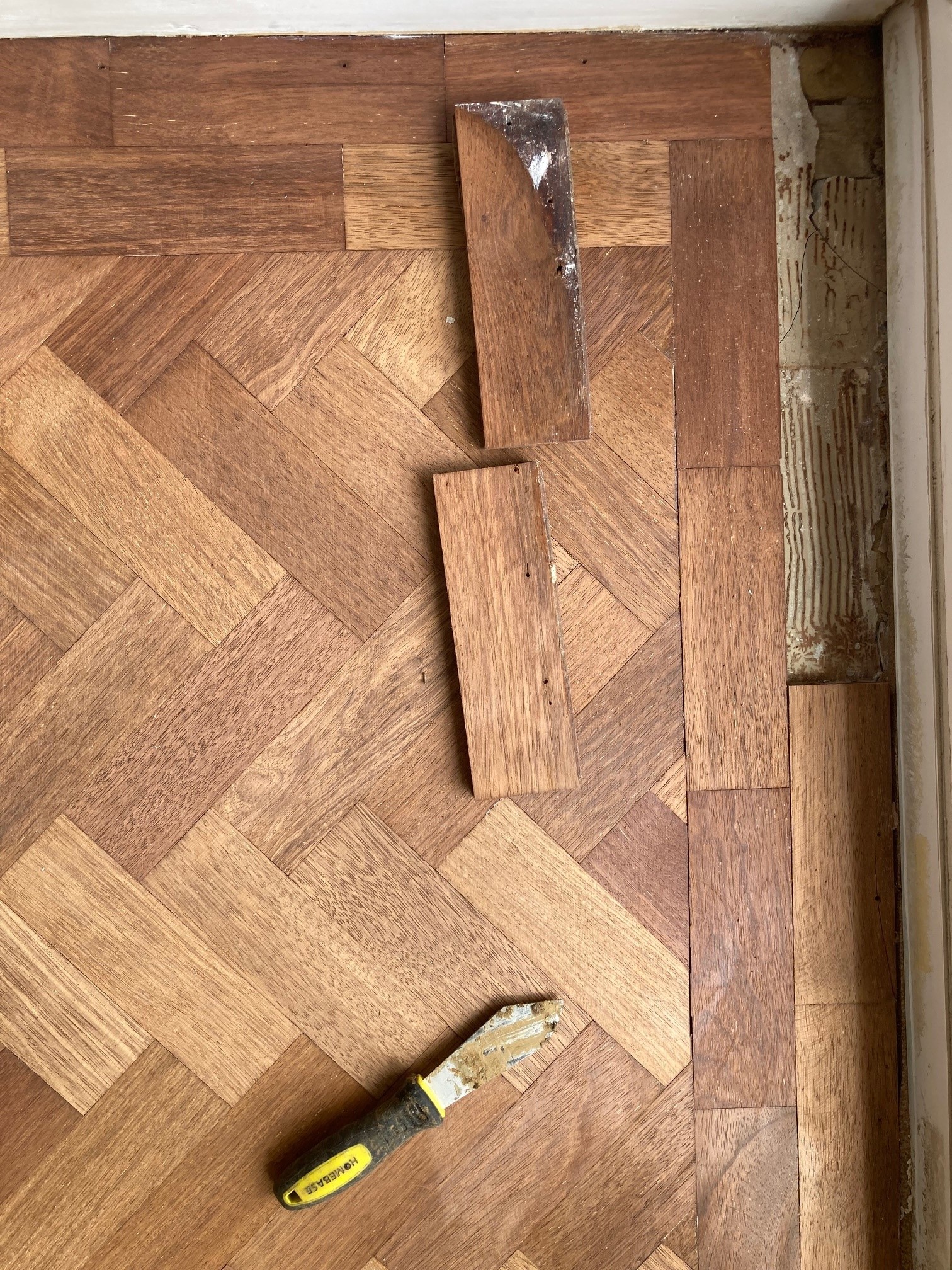
If you have noticed a gap in a parquet floor, or a block that has worked loose and split, it is natural to wonder whether the damage can be put right without lifting the whole floor. The honest answer is that missing parquet blocks can often be replaced. In many cases, the repair can be made to sit comfortably within the original floor, provided the right block is used and the surrounding floor is stable.
The quality of the result depends on practical factors: the age of the floor, the species and size of the timber, the pattern, the condition of the surrounding blocks and the care taken during fitting, sanding and finishing. A single missing block is a different problem from a large missing section, and a repair on a dry, stable floor is different from one affected by moisture or widespread movement.
This guide explains what is realistic when parquet blocks are missing, how matching works, when a small repair is enough, and when the floor should be viewed as part of wider parquet floor sanding and restoration work.
The Short Answer: Replacement Is Usually Possible
Yes, missing parquet blocks can often be replaced. Flooring specialists who work with parquet regularly find floors where individual blocks are missing, cracked, split or too damaged to reuse. The usual approach is to source suitable replacement blocks, fit them securely, then sand and finish the floor so the repair blends as naturally as possible.
The important word is suitable. A replacement block needs to match more than just the timber species. It needs to be the right size, thickness, grain direction and pattern orientation. If those details are wrong, the repair may be structurally sound but visually obvious.
For one or two missing blocks, replacement is usually a local repair. Where several areas are missing, or where missing blocks sit alongside loose blocks, damp patches or uneven sections, the work may become part of a wider restoration plan.
Why Parquet Blocks Go Missing Or Become Damaged
Parquet floors rarely lose blocks for no reason. Most missing blocks are the end result of a problem that has been developing for some time. Understanding the cause matters because replacing a block without correcting the reason it failed can lead to the same issue returning.
Loose blocks that were never refitted
One common scenario is simple: a block worked loose, was lifted out during decorating or carpet fitting, and was never put back. If the surrounding floor is otherwise stable, this may be one of the easier repairs.
Water damage
Water can swell timber, weaken old adhesive and distort blocks. A block affected by a leak may no longer sit flat or may have softened too much to reuse. In those cases, replacement is usually more sensible than forcing damaged timber back into place.
Previous renovation work
Parquet is often found beneath old carpets, hearth alterations, built-in furniture, cupboards and partitions. When fixtures are removed, missing blocks may appear where the floor was cut around previous work.
Adhesive failure
Older parquet floors often rely on adhesives that eventually lose strength. As blocks loosen, edges can chip or split, and some blocks may be removed or lost altogether. If this is the underlying issue, it is worth understanding why parquet blocks become loose before deciding how far the repair needs to go.
Impact or heavy furniture
Dropped objects, dragged furniture and concentrated weight can crack individual blocks. The damaged block may need replacing if it has split across the grain or no longer sits securely.
Poor previous repairs
Some missing blocks are the result of earlier repairs where unsuitable timber, poor adhesive or rushed preparation was used. If an old repair has failed, the new repair needs to deal with the cause rather than simply filling the gap again.
How Professionals Decide Whether Missing Blocks Can Be Replaced
A professional assessment looks at the missing block, but it also looks beyond the visible gap. The question is not only whether a block can be fitted. The question is whether the repair will remain stable once the floor is sanded, finished and used.
The main things to check are the number of missing blocks, whether matching timber is available, the pattern, the depth and size of the existing blocks, the condition of the subfloor, moisture history, previous repairs and whether the surrounding blocks are secure.
This whole-floor view protects the homeowner from a patch that looks acceptable on day one but fails because the surrounding floor was unstable or damp.
Where Replacement Blocks Usually Come From
Salvaged original blocks
The best match is usually an original block from the same floor. Sometimes spare blocks are found under cupboards, around old alterations or in areas that can be discreetly reworked. This is not always possible, but when it is, the match is usually the most natural.
Reclaimed parquet
Reclaimed parquet blocks can work well because the timber has already aged. They may come from floors removed during renovations or demolitions. They still need checking carefully because size, thickness, adhesive residue and condition can vary significantly.
New timber cut to size
Where reclaimed blocks are not available, new timber may be cut to size. This can be a practical solution, especially when only a small number of blocks are missing. New timber will not have the same aged colour at first, but sanding and finishing can usually reduce the contrast.
Blocks made to match unusual floors
Some older parquet floors use sizes or species that are not easy to buy off the shelf. In those situations, replacement blocks may need to be made to match the existing dimensions. This can improve the repair but does not remove the natural colour and grain variation that comes with timber.
Can New Parquet Blocks Match Old Ones?
A good match is often possible, but a perfect match should never be promised. Old parquet has usually changed colour through age, sunlight, cleaning products and previous finishes. Even timber from the same species can vary in grain, density and tone.
| Replacement source | Typical outcome | What to consider |
|---|---|---|
| Original blocks from the same floor | Usually the best visual match | Availability is the main limitation |
| Reclaimed blocks from a similar floor | Often a very good match | Size, thickness and adhesive residue must be checked |
| New matching timber | Can blend well after sanding and finishing | May look brighter at first and mellow over time |
| Different timber species | Usually more noticeable | May be acceptable in small areas but is harder to disguise |
Matching works across three practical areas: size, pattern and appearance. A block that is too thick can sit proud. A block laid in the wrong direction can interrupt the pattern. A block with the wrong colour or grain can draw the eye after finishing. The best repairs respect all three.
Can New Parquet Blocks Be Stained To Match Old Parquet?
Staining can help, but it is not a magic solution. A stain can adjust tone, reduce contrast and help new timber sit more comfortably beside old timber. It cannot change the grain, density or age of the wood. This is why the physical match of the block still matters before colour work begins.
In many cases, replacement blocks blend best after the whole floor has been sanded and finished together. If only the new block is stained and finished in isolation, the repair is more likely to stand out because the surrounding floor still carries its old finish and age marks.
When Replacement Becomes Difficult
Some parquet floors are straightforward to repair. Others require more caution. Difficulty increases when the original timber is unusual, the block size is no longer common, the floor has been heavily stained, or reclaimed blocks are coated in old adhesive that cannot be cleaned properly.
Black resin or old bitumen residue can be especially awkward. Blocks previously fixed with these materials may be difficult to clean and reuse without damage. In some cases, new timber cut to size is a more reliable option than trying to force contaminated reclaimed blocks into service.
When matching is no longer the main problem
Sometimes the biggest issue is not matching at all. If the subfloor is damp, the adhesive has failed over a large area, or the surrounding blocks are loose, a perfectly matched replacement block will still not solve the problem. The floor has to be stable before the repair can perform properly.
Why Missing Blocks Should Be Replaced Before Sanding
Missing blocks should be replaced before sanding begins. Sanding a floor with open gaps leaves those gaps in place and makes later repairs harder to blend. If blocks are fitted first, the new and old timber can be sanded together, helping the repaired area become part of one continuous surface.
This is the same repair-first logic used when loose parquet should be repaired before sanding. The preparation stage protects the final finish. Sanding improves the surface, but it does not correct missing timber or instability beneath the floor.
Where replacement blocks are fitted as part of a full wood floor restoration, the repair, sanding and finishing stages can be planned together. That usually gives a more consistent result than a patch repair carried out after the floor has already been finished.
What A Full Parquet Restoration Involves
A full parquet restoration usually begins with assessment. The specialist checks which blocks are missing, which are loose, which are damaged and whether moisture or subfloor problems are present. The aim is to decide which blocks can be saved, which need replacing and whether the floor is stable enough for sanding.
Once repairs are complete, the floor can be sanded to remove old finish and level the surface across both original and replacement blocks. The floor is then cleaned and finished with a suitable oil, lacquer or other finish system. The result should read as one floor rather than a collection of individual patches.
This is why missing-block repairs often belong naturally within parquet floor repairs or wider restoration work rather than being treated as an isolated cosmetic task.
When Is A Missing Block A Small Repair And When Is It A Bigger Problem?
| Floor situation | Typical recommendation | Why it matters |
|---|---|---|
| One missing block | Usually local replacement | The surrounding floor may remain stable |
| Small missing patch | Patch repair and sanding | Several blocks may need to be blended together |
| Several missing areas | Wider repair assessment | The cause may be more than isolated damage |
| Missing blocks plus loose blocks | Repair before sanding | Movement can affect the final finish |
| Missing blocks plus moisture history | Investigate moisture first | New blocks may fail if damp remains |
| Large missing section | Restoration assessment | Matching, levels and structure need planning |
| Subfloor movement | Further investigation | The base must be stable before repair |
This kind of decision table is useful because it keeps the focus on scale and cause. One missing block is rarely a reason to replace the whole floor. A missing block combined with moisture, movement and widespread failure needs a more careful assessment.
Is My Parquet Floor Still Worth Restoring?
Many homeowners assume missing blocks mean the floor is no longer worth saving. In practice, the answer depends on how much of the original floor remains and whether the base is still sound.
- The parquet pattern remains mostly intact.
- Most original blocks are still present.
- Missing sections are limited rather than widespread.
- The surrounding timber is firm rather than soft or rotten.
- The subfloor appears stable.
- There is no obvious ongoing moisture problem.
- Suitable replacement blocks can be sourced or made.
If several of these points apply, the floor is usually worth assessing for restoration before replacement is considered. The future sibling article on whether parquet floor restoration is worth it should become the natural next read for homeowners weighing repair against replacement.
Signs Further Investigation May Be Needed
- Large sections of parquet are missing.
- Blocks are missing in several unrelated areas.
- The floor has a history of leaks, damp or staining.
- The surrounding blocks are loose, hollow or moving.
- Previous repairs have failed more than once.
- The subfloor feels uneven, flexible or unstable.
- The timber is soft, crumbling or badly distorted.
These signs do not automatically mean the floor must be replaced. They mean the visible missing blocks may be only part of the story. The cause should be understood before money is spent on matching blocks and finish work.
Common Homeowner Mistakes
- Assuming one missing block means the whole parquet floor is ruined.
- Choosing a replacement block based only on colour.
- Ignoring thickness, size and pattern direction.
- Fitting replacement blocks before resolving moisture issues.
- Trying to finish a replacement block separately after the floor has been sanded.
- Expecting reclaimed blocks from another floor to be identical.
- Leaving open gaps for too long and allowing dirt or moisture into the floor.
Most mistakes come from treating the gap as the whole problem. A missing block is the visible symptom. The repair works best when the cause, the surrounding floor and the finishing plan are considered together.
Common Misconceptions About Replacing Parquet Blocks
Missing parquet always means replacement
Not usually. Individual blocks and small sections can often be replaced without lifting the whole floor.
A repaired floor will always be invisible
A careful repair can blend very well, but exact invisibility cannot always be guaranteed, especially on older floors with aged timber.
Any block of the same timber will do
The species matters, but so do size, thickness, direction, grain and finish response.
One missing block is unimportant
A gap allows dirt and moisture into the floor and leaves neighbouring edges vulnerable, so early repair is usually sensible.
All reclaimed blocks are suitable
Reclaimed blocks still need checking. Old adhesive, damage, wrong thickness or different dimensions can make them unsuitable.
Old parquet cannot be restored
Many older parquet floors can be restored successfully if the structure, timber and subfloor are still serviceable.
What To Expect After Replacement And Sanding
After replacement and sanding, a good parquet repair should feel level, secure and visually balanced within the floor. The repaired area may still show some natural variation, especially if new timber has been used beside very old timber. That is not necessarily a failed repair; it is part of working with a natural material.
Colour differences often reduce once the whole floor is finished, and further mellowing can happen naturally with light and use. The realistic goal is a stable, well-blended repair that respects the pattern and protects the floor’s future life.
Final Thoughts
Missing parquet blocks can often be replaced. The best results come from matching the block properly, understanding why the block went missing, securing the repair before sanding and finishing the whole floor in a way that helps old and new timber sit together.
A small missing area may be a straightforward repair. A floor with missing blocks, loose sections, moisture signs or previous failed repairs may need a wider restoration assessment. The key is not to assume the floor is beyond saving, but also not to assume every patch will be invisible.
With the right assessment and realistic expectations, many parquet floors with missing sections remain well worth restoring.
Frequently Asked Questions
Can missing parquet blocks be replaced?
Yes. Missing parquet blocks can often be replaced with suitable reclaimed blocks or new timber cut to size. The repair works best when the block matches the existing floor in size, thickness, pattern direction and general appearance.
Can you match old parquet blocks?
A close match is often possible, especially if original or reclaimed blocks are available. However, old timber changes colour over time, so an exact match should not be promised before the floor has been assessed.
Will replacement parquet blocks stand out?
They may be visible on close inspection, particularly on older floors. Sanding and finishing the whole floor together usually gives the best chance of blending the repair.
Can reclaimed parquet be used for repairs?
Yes, reclaimed parquet can be useful because it has already aged. It still needs checking for size, thickness, timber condition and old adhesive residue before it is fitted.
Can new parquet blocks be stained to match old parquet?
Staining can help adjust colour, but it cannot change grain, age or timber density. The physical match of the block still matters before any colour adjustment is considered.
Is it better to repair or replace a parquet floor?
If the majority of the floor is sound and the missing areas are limited, repair and restoration are often worth considering. Replacement becomes more likely where damage is widespread, damp is ongoing or the floor cannot be stabilised.
What causes parquet blocks to go missing?
Common causes include loose blocks that were removed and not refitted, water damage, previous renovation work, adhesive failure, impact damage and poor previous repairs.
Should missing blocks be replaced before sanding?
Yes. Missing blocks should normally be fitted before sanding so the whole floor can be sanded and finished together. This gives the repair a better chance of blending with the surrounding parquet.
Recommended Posts
How Does Dust-Controlled Floor Sanding Work?
08/08/2026
Is Parquet Floor Restoration Worth It?
06/08/2026
Testimonial Five
See more of our customer reviews at Checkatrade.com
YOU’RE IN GOOD HANDS






Contact our local carpet cleaners and local floor sanders near you to discover more about a full selection of floor restoration services.
Contact Us