
Why Do Parquet Blocks Become Loose?

by Darren Admin
Parquet flooring has a distinctive look that many UK homeowners value, especially in older properties where the geometric timber blocks add warmth, pattern and character. When the floor is stable, parquet feels solid underfoot. When individual blocks begin to loosen, the floor can start to sound hollow, click, rock or shift slightly as people walk across it.
Loose parquet blocks do not automatically mean the whole floor needs replacing. In many cases, the timber blocks are still sound and the problem lies with the adhesive, the subfloor, moisture exposure or earlier installation. The important step is understanding why the blocks have moved before deciding whether a local repair, wider stabilisation or full parquet restoration is needed.
This article explains the most common causes of loose parquet blocks, how to recognise whether the problem is local or more serious, and why loose areas should normally be dealt with before sanding or refinishing work begins.
What Does A Loose Parquet Block Feel Like?
Loose parquet blocks are usually noticeable once you know what to look for. The clearest sign is movement underfoot. One block, or a small group of blocks, may rock slightly, dip at one corner or feel different from the surrounding floor.
Hollow sounds are another common clue. A block that sounds hollow when tapped may have lost its bond to the subfloor. Clicking sounds when walking across the floor often mean a block is moving against nearby blocks or against the surface beneath it.
In more advanced cases, edges may lift, gaps may open, or blocks may become proud of the surrounding floor. These signs suggest the issue has been developing for some time and should be assessed before the movement spreads.
The Main Causes Of Loose Parquet Blocks
There is rarely one single cause behind every loose parquet block. Often several factors work together. The table below gives a quick homeowner-friendly overview before we look at the main causes in more detail.
| Cause | Typical sign | What it means for the floor |
|---|---|---|
| Adhesive failure | Hollow sounds or blocks moving in patches | The bond beneath the blocks has weakened and may need renewing |
| Moisture or water damage | Lifting edges, staining, damp smell or distortion | The moisture source must be understood before repair |
| Unstable subfloor | Movement across a larger area | Blocks may not stay bonded until the base is stable |
| Installation issues | Patchy looseness or blocks pressing against each other | The original layout or preparation may not have allowed for movement |
| Age and wear | Older blocks loosen while timber still looks sound | The timber may be fine but the fixing material has aged |
Adhesive failure
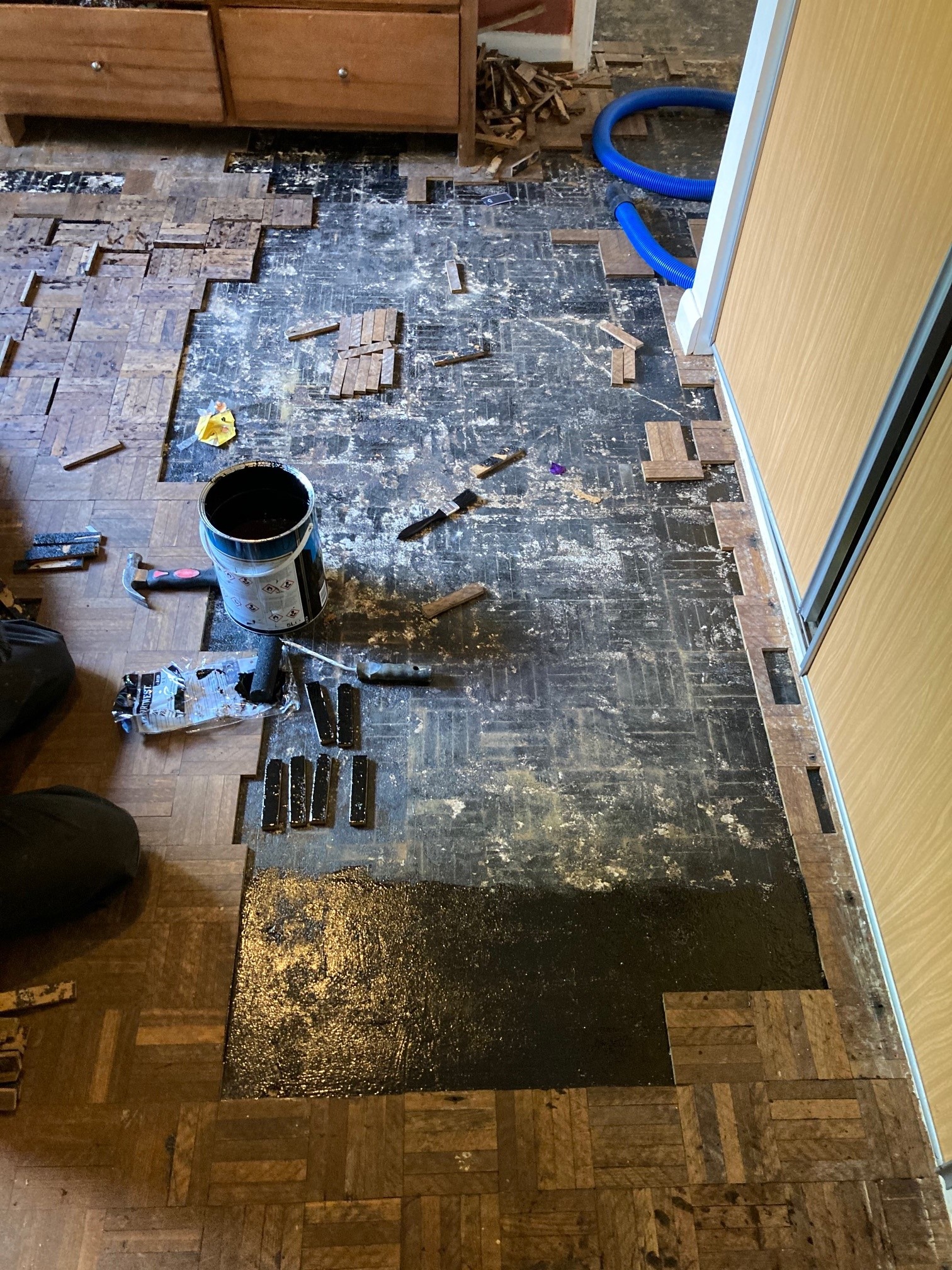
One of the most common causes of loose parquet blocks is adhesive breakdown. Parquet blocks are fixed to the subfloor with adhesive, and that bond can weaken over time. Many older parquet floors were laid with bitumen or older mastics that can become brittle, dry or crumbly after decades of use.
Adhesive failure does not always happen evenly. One corner of a room may sound hollow while another area feels completely solid. That patchy pattern is common because adhesive condition can vary across the same floor.
Moisture and water damage
Moisture can weaken the adhesive beneath parquet and can also make timber expand, shrink or distort. A leaking radiator, dishwasher leak, plant pot, damp concrete subfloor, poorly sealed threshold or repeated moisture near patio doors can all contribute to loose blocks.
The visible surface does not always show the full moisture history. Blocks may look reasonably clean while the adhesive beneath has softened or failed. This is why moisture should be considered whenever blocks are lifting, edges are raised or the loose area is near a known water source.
Seasonal expansion and contraction
Wood moves with changes in temperature and humidity. Small seasonal movement is normal, but repeated expansion and contraction can place stress on old adhesive bonds, especially where blocks were laid too tightly or where the room experiences strong temperature swings.
Areas close to large windows, fireplaces, underfloor heating, external doors and conservatories can be more vulnerable because the floor experiences greater environmental changes.
An unstable subfloor
A parquet floor is only as stable as the surface beneath it. If the subfloor moves, flexes, cracks or remains damp, the blocks above it can work loose. Older timber subfloors, uneven concrete and previous repair areas can all create this problem.
Simply sticking the blocks back down may not last if the movement beneath them is still present. The base needs to be understood before a reliable repair can be recommended.
Installation issues
Some parquet floors develop loose blocks because of how they were originally fitted. Insufficient adhesive, poor subfloor preparation, uneven compounds, blocks laid too tightly or timber laid with unsuitable moisture content can all lead to movement later.
Installation problems may take years to appear, which is why they are sometimes mistaken for ordinary age-related wear.
Why Older Parquet Floors Often Develop Loose Blocks
Older parquet floors often loosen because the adhesive has aged, not because the timber has failed. This is an important distinction. The wooden blocks may still have many years of useful life left, even if the bonding material beneath them has reached the end of its serviceable life.
This is why age alone should not be used to decide whether a parquet floor is worth saving. A floor that is several decades old can still be a good restoration candidate if most blocks are present, the pattern is intact, moisture is controlled and the subfloor is stable.
Can A Loose Parquet Floor Still Be Restored?
Yes, many parquet floors with loose blocks can still be restored. Individual blocks can often be lifted, cleaned and re-bonded. Small loose areas can often be stabilised. Missing or damaged blocks can sometimes be replaced with matching or close-matching timber before the floor is sanded and finished.
Where the issue is more widespread, wood floor restoration may involve a broader repair-first approach: identifying loose areas, checking the subfloor, resolving moisture concerns, re-securing blocks, replacing damaged sections where possible and then sanding and finishing the floor as a complete surface.
The realistic expectation is that restored parquet can often look very good, but exact invisibility is not always possible. Older timber changes colour with age and light exposure, so replacement blocks may blend well after sanding and finishing, but they may not match perfectly.
What Happens If Loose Blocks Are Ignored?
Loose parquet rarely improves on its own. Once a block moves, each step can wear the remaining adhesive and damage the edges of nearby blocks. A small loose area can gradually become a larger loose area.
Movement can also allow dust, grit and moisture into the gaps around the block. Over time, that can make the repair more involved, especially if edges become rounded, blocks break, or the surrounding pattern starts to distort.
There is also a practical safety issue. A block that rocks or lifts can become a trip hazard, particularly in hallways, doorways and high-traffic paths through the home.
Should Loose Blocks Be Repaired Before Sanding?
Loose parquet should normally be repaired before sanding begins. Sanding does not bond a loose block back to the subfloor. It only changes the surface. If the block is moving, sanding can make the movement more obvious, disturb the surrounding pattern or leave the finished surface uneven.
Repairing loose blocks before sanding gives the floor a stable base. Once the loose areas are secure, sanding and finishing can help blend the repaired section into the rest of the floor.
If you are planning a wider restoration, the question is not simply whether the floor can be sanded. It is whether the floor is stable enough to sand. Loose parquet should be repaired before sanding where movement is present.
Repair Vs Replacement
The right decision depends on the scale and cause of the problem. A few loose blocks are very different from large-scale adhesive failure across a whole room.
| Situation | Typical recommendation | What to consider |
|---|---|---|
| One loose block | Usually repair | Block condition and adhesive residue should be checked |
| Small localised area | Repair and stabilise | Often suitable for re-bonding before sanding |
| Several isolated loose patches | Repair plus wider assessment | May suggest ageing adhesive in more than one area |
| Large area of adhesive failure | Detailed assessment | Repair may still be possible, but scope increases |
| Moisture-damaged section | Resolve moisture first | Repair will not last if damp conditions remain |
| Large unstable floor | Assess repair versus replacement | Economics and long-term stability matter |
| Missing or broken blocks | Replacement may be possible | Availability of matching blocks affects expectations |
Signs Your Loose Parquet Is Still Worth Saving
The following signs usually point towards a floor that may still have good repair or restoration potential.
- Most of the original blocks are still present.
- The parquet pattern remains intact.
- Loose areas are localised rather than spread across the whole floor.
- There is no obvious ongoing moisture problem.
- Most blocks remain firm underfoot.
- The timber itself is not badly split, rotten or crumbling.
- The subfloor feels broadly stable.
These signs do not guarantee that restoration is the right decision, but they are positive indicators that the floor deserves a proper assessment before replacement is considered.
Signs The Problem May Be More Serious
Some symptoms suggest the issue may go beyond a few loose blocks.
- Large sections of the floor sound hollow.
- Blocks lift in several different areas of the room.
- There is staining, damp smell or a known history of leaks.
- Previous repairs have failed repeatedly.
- Blocks are broken, soft or badly distorted.
- The subfloor moves or flexes underfoot.
- The floor has large gaps or significant pattern distortion.
These signs do not automatically mean the floor must be replaced, but they do mean the repair decision needs to be based on a detailed assessment rather than a quick surface fix.
How Professionals Assess Loose Parquet Blocks
A flooring specialist will usually begin by identifying where the movement is happening and whether the affected areas are isolated or widespread. Tapping the floor can help reveal hollow areas, but the surface sound is only part of the assessment.
The condition of the subfloor, the type of adhesive, the presence of moisture, the state of the timber and the history of previous repairs all influence the final recommendation. If the subfloor is unstable or damp, re-bonding blocks without dealing with the cause is unlikely to last.
A professional parquet floor sanding and restoration assessment should therefore look at both the blocks and what is happening beneath them. The goal is to identify a repair that will remain stable once sanding and finishing are complete.
What Influences The Right Repair Solution
The extent of the damage is the first factor. A handful of loose blocks can often be lifted, cleaned and re-bonded individually. Larger areas may need a more methodical stabilisation process.
The type of old adhesive matters as well. Old bitumen or crumbly compounds may need careful preparation before new adhesive can perform properly. If blocks are simply pressed back onto failing residue, the repair may not hold.
The condition of the blocks also affects the end result. Sound blocks can often be reused. Damaged or missing blocks may require selective replacement. When replacing missing parquet blocks, exact matches are not always available, so realistic expectations are important.
Common Misconceptions About Loose Parquet Blocks
Sanding will fix loose blocks
Sanding restores the surface. It does not re-bond loose blocks. Movement should be dealt with before sanding begins.
The whole floor will need replacing
Not necessarily. Many loose parquet problems are localised and can be repaired without replacing the entire floor.
Loose blocks are only cosmetic
A block that moves underfoot is a practical problem, not just a visual one. Movement can damage surrounding blocks and make repairs larger over time.
Glue alone fixes everything
Adhesive matters, but preparation matters just as much. The old adhesive, moisture condition and subfloor stability all influence whether the repair will last.
Old parquet is beyond saving
Many older parquet floors are still worth saving. Often the adhesive has failed before the timber itself has reached the end of its life.
A Homeowner’s Checklist
Before arranging an assessment, it helps to gather practical information about what you have noticed.
- Walk the floor slowly and note every area where blocks move underfoot.
- Listen for clicking or hollow sounds in different parts of the room.
- Look for lifting edges, open joints or blocks sitting higher than nearby blocks.
- Check whether the loose areas are near radiators, doors, patio doors, kitchens or known leak points.
- Avoid dragging heavy furniture across loose areas until the floor has been assessed.
- Take clear photos of the loose areas and any staining, gaps or missing blocks.
This information helps a flooring specialist understand the scale of the issue and whether the first concern is local repair, moisture, subfloor movement or wider restoration.
When To Call A Professional
It is sensible to call a professional when blocks are moving underfoot, several areas sound hollow, there are signs of water damage, or you are planning sanding and want to avoid making the floor worse.
A specialist can identify whether the problem is likely to be a few loose blocks, wider adhesive failure, moisture-related movement or subfloor instability. That distinction matters because the repair method changes depending on the cause.
If the floor is otherwise worth saving, professional parquet floor repairs followed by careful sanding and finishing can often bring the surface back to a stable, consistent condition. Where the damage is more widespread, a broader restoration plan may be more appropriate than a small patch repair.
Final Thoughts
Parquet blocks usually become loose because the bond beneath them has failed, moisture has affected the floor, the subfloor is moving, or the original installation did not allow the floor to behave properly over time.
The good news is that loose parquet does not automatically mean replacement. Many floors can be repaired, stabilised and restored when the issue is caught early and the cause is properly understood.
The best decision is based on cause, scale and condition. A single loose block, a small loose area and a room with widespread adhesive failure all need different levels of attention.
Frequently Asked Questions
Why are my parquet blocks moving underfoot?
Parquet blocks usually move because the adhesive beneath them has weakened, moisture has affected the bond, or the subfloor is moving. In older floors, the timber may still be sound while the original fixing material has started to fail.
Can loose parquet blocks be repaired?
Yes, many loose parquet blocks can be repaired. Individual blocks or small areas can often be lifted, cleaned and re-bonded. Larger loose areas may need wider stabilisation before sanding or finishing work is considered.
Should loose parquet be repaired before sanding?
Usually, yes. Sanding over loose blocks can worsen movement and affect the final finish. Loose areas should normally be stabilised before sanding so the floor is sound before surface work begins.
What causes parquet adhesive to fail?
Adhesive can fail because of age, moisture, poor subfloor preparation, seasonal movement, old bitumen breakdown, installation issues or movement in the base beneath the floor.
Can old parquet flooring still be restored?
Often, yes. Older parquet can still be restorable if the blocks are sound, most of the pattern remains intact and the subfloor is stable. Age alone is not the deciding factor.
Is it better to repair or replace loose parquet?
Small loose areas are often repairable. Replacement is usually considered when damage is widespread, moisture is severe, large sections are missing, or the floor is no longer economical to stabilise and restore.
Recommended Posts
How Does Dust-Controlled Floor Sanding Work?
08/08/2026
Is Parquet Floor Restoration Worth It?
06/08/2026
Testimonial Five
See more of our customer reviews at Checkatrade.com
YOU’RE IN GOOD HANDS






Contact our local carpet cleaners and local floor sanders near you to discover more about a full selection of floor restoration services.
Contact Us