
Whitewashed Wooden Floors: White Oil vs White Stain vs Lacquer

by Darren Admin
Whitewashed wooden floors have become one of the most popular finish styles in modern homes. Their light, pale appearance works especially well in contemporary interiors, Scandinavian-inspired rooms, period homes that need brightening, and darker spaces where homeowners want the floor to feel cleaner, softer and more open.
But although the phrase “whitewashed wooden floors” sounds simple, it can mean several different things in practice.
Some homeowners imagine a soft, natural-looking pale oak floor. Others want a stronger limed appearance where the grain has a more visible white pigment. Some want a cleaner, more uniform white effect with higher durability for busy family use. Each of those outcomes can be described as whitewashed, but they are not always achieved using the same product or finishing system.
In real floor finishing work, a whitewashed effect may be created using white oil, white stain, white hardwax oil, white primer, white pigment lacquer, or a combination of colour and protective finish systems. Each behaves differently on timber. Each produces a different look. Each has different strengths and limitations.
The right choice depends on the wood species, the floor condition, the level of traffic, the preparation carried out before finishing, and how natural or controlled the final colour needs to be.
This is why successful whitewashed flooring normally starts before the colour is applied. The floor needs to be assessed, prepared and sanded correctly so the chosen finish has the best chance of looking even, durable and appropriate for the room. Poor preparation can leave even a good finish looking patchy, artificial or disappointing.
Where appropriate, this type of finish is usually part of a wider floor refinishing process rather than a separate standalone service. The colour choice, surface preparation and final protective system all need to work together.
What Whitewashed Wooden Floors Actually Mean
A whitewashed wooden floor is not one specific product. It is a visual effect.
In simple terms, it describes a wooden floor that has been lightened using a white or pale pigment while still allowing the natural grain and texture of the timber to remain visible.
The final appearance can vary from very subtle to much more pronounced. For example, a whitewashed floor may have:
- a soft pale wash that gently reduces yellow or orange tones
- a more obvious limed appearance where the grain shows visible white pigment
- a chalkier, Scandinavian-style finish
- a semi-opaque white effect that gives stronger colour change
- a natural pale oak appearance with minimal surface build
- a more uniform white coating designed for durability and easier maintenance
This is why two people can ask for a whitewashed floor and mean very different things.
One homeowner may want the floor to look almost untreated but slightly lighter. Another may want a more styled interior-design finish with clearly visible white pigment. Another may simply want to reduce the yellow tone in old oak flooring without making the floor look painted.
The most important point is that the finish should suit the floor. A whitewashed effect that looks beautiful on one timber species may not look the same on another.
Traditional Limewash vs The Modern Limed Look
Many people still use the words “limewashed” or “limed” when describing pale wooden floors. Historically, limewash was used to create a lightened effect on timber surfaces. However, traditional limewash is not usually the best practical choice for modern wooden floors because it does not offer the durability most homes need today.
When someone asks for a limewashed floor now, they are usually asking for the appearance of a limed floor rather than traditional limewash itself.
That modern limed appearance is usually created with one of the following systems:
- white oil
- white hardwax oil
- white stain
- white primer
- white pigmented lacquer
- a colour system followed by a protective oil or lacquer finish
These modern systems allow a floor to achieve the pale, washed or limed appearance while still being suitable for normal household use.
The key difference is that each system works in a different way. Some penetrate the timber. Some alter the colour more strongly. Some form a protective film on the surface. Some look very natural. Others provide better durability but may appear more uniform.
Choosing between them is not just a question of colour. It is a question of how the floor will look, feel, wear and be maintained over time.
Why The Same White Finish Can Look Different On Two Wooden Floors
One of the biggest surprises for homeowners is that the same white finish can look completely different from one floor to another.
This is where many whitewashed floor projects can go wrong if the finish is chosen only from an online photograph.
A whitewashed oak floor seen on a design website may have been photographed in strong natural light, on newly installed timber, with a carefully chosen finish and professional preparation. Applying a similar finish to an older pine floor, a previously stained floor, or a repaired parquet floor may produce a noticeably different result.
The finished appearance is affected by several factors:
- wood species
- grain structure
- age of the floor
- previous sanding or staining
- old residues in the timber
- repairs or replacement boards
- how evenly the floor absorbs pigment
- the final protective coating used
Oak normally responds very well to white finishes because the grain structure often accepts pale pigment in an attractive and controlled way. Pine and other softwoods can be less predictable because they may absorb pigment unevenly, especially on older floors.
Parquet flooring adds another layer of complexity because pattern definition matters. Too much pigment can flatten the appearance of the blocks and reduce the natural contrast that makes parquet attractive.
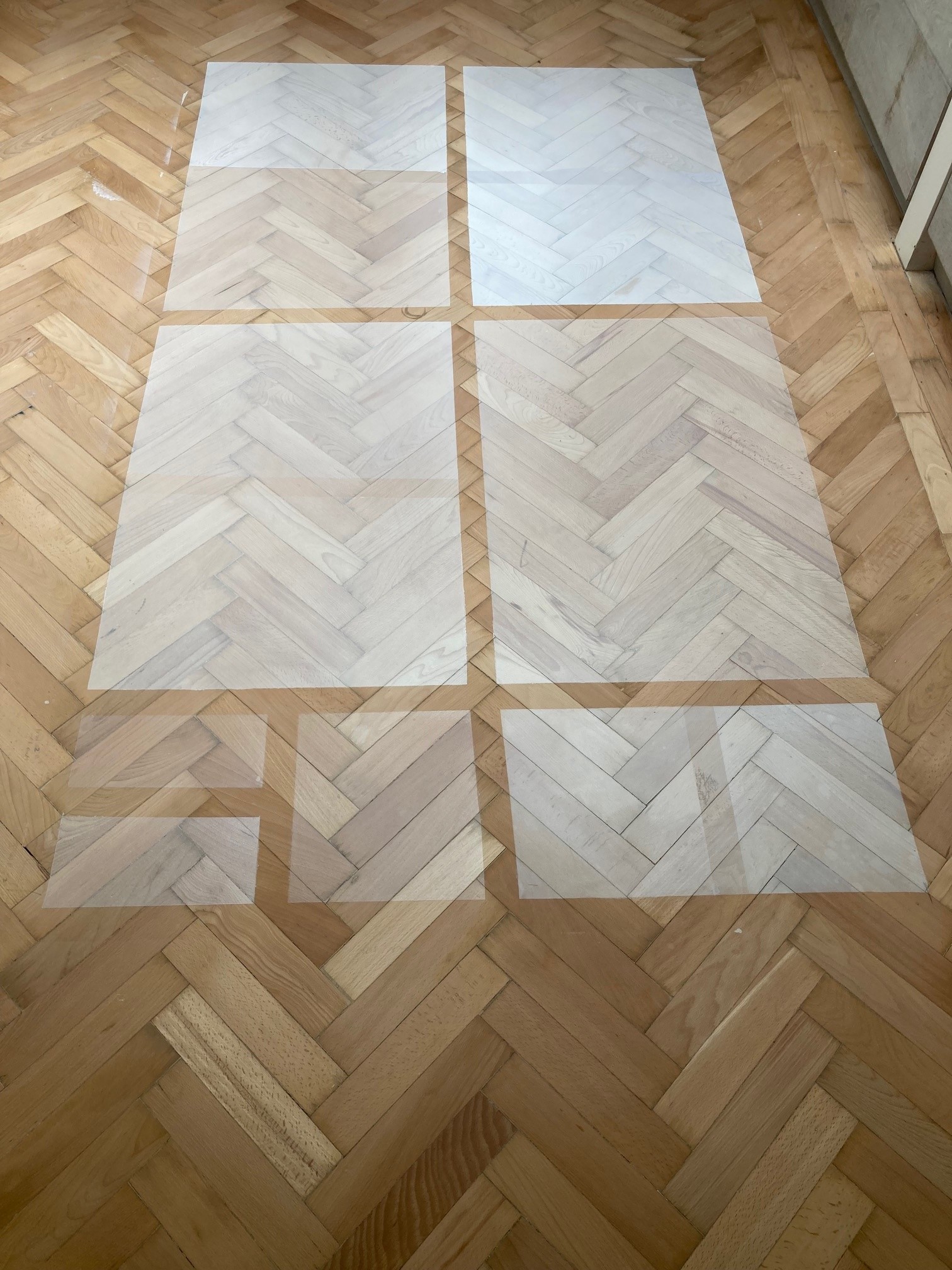
This is why sample testing is often one of the most important parts of choosing a whitewashed finish. A test area shows how the finish behaves on the actual floor in the actual room, not just how it looked in a photograph somewhere else.
Why Preparation Matters Before Whitewashing A Floor
The quality of the preparation has a major effect on the final result of a whitewashed wooden floor.
White and pale finishes tend to reveal uneven preparation more than many darker finishes. Scratches, sanding marks, old finish residues and uneven absorption can all become more visible once white pigment is introduced.
This is one reason why whitewashed floors should not be treated as a quick colour change.
Before applying a white oil, stain or lacquer system, the floor may need:
- careful sanding to remove old coatings
- controlled finishing cuts to reduce sanding marks
- repairs to loose or damaged boards
- attention to gaps or uneven areas
- cleaning to remove residues
- sample testing to confirm colour behaviour
- assessment of how the final finish will wear in the room
Good preparation gives the finish a better chance of applying evenly and looking intentional rather than patchy.
This is particularly important on older floors. Historic coatings, waxes, stains and replacement boards can all affect the way pigment behaves. If these are not identified before finishing, the final result may be inconsistent.
Professional floor finishing is not just about applying a product. It is about understanding how the floor will respond before committing to the full area.
How Sample Testing Helps Avoid Expensive Mistakes
Sample testing is one of the most useful steps when choosing a whitewashed wooden floor finish.
It allows the homeowner to see how the selected white oil, stain or lacquer behaves on the actual timber before the whole floor is finished. This matters because a finish that looks perfect on one floor may not produce the same appearance on another.
A sample area can help reveal:
- whether the timber accepts pigment evenly
- whether the colour appears too strong or too weak
- whether old residues or repairs are affecting the result
- whether the finish looks natural or artificial
- whether the grain remains visible enough
- whether a different system may be more suitable
This is especially important with pine, parquet, engineered floors and older boards that may have been treated before.
Sample testing does not remove every variable, because the full floor may still contain natural colour differences. However, it gives a much clearer understanding of what is realistic before committing to the complete floor.
For whitewashed finishes in particular, sample testing can prevent one of the most common problems: choosing a finish from a photograph and discovering too late that the real floor reacts differently.
White Oil For Wooden Floors
White oil is one of the most popular choices for homeowners who want a natural whitewashed effect.
Rather than sitting only on top of the floor, white oil penetrates the timber and carries pigment into the grain. This can create a softer, more natural appearance than some surface coatings.
White oil is often chosen when the goal is to reduce warm yellow or orange tones while still preserving the natural character of the wood.
Typical advantages of white oil include:
- a natural timber appearance
- visible grain detail
- a softer, less coated look
- good suitability for oak floors
- the ability to carry out localised maintenance more easily than some lacquer systems
- a finish that can feel more traditional and less artificial
White oil often works especially well on oak because oak has a grain structure that can hold pale pigment attractively. The result can be bright and natural without looking like the floor has been painted.
It can also work well on parquet floors when the aim is to lighten the overall tone while keeping the pattern and block detail visible. In those situations, the preparation and sanding process are especially important because the finish must enhance the pattern rather than flatten it. More information about this type of work can be found on our parquet floor sanding and restoration page.
The main trade-off with white oil is maintenance. Oiled floors can look beautiful, but they usually need periodic care to keep them protected and looking their best. For some homeowners, that is a worthwhile exchange because the appearance is often more natural and repairable than a heavily coated surface.
When White Oil May Not Be The Best Choice
White oil is not the right finish for every floor or every household.
In very busy homes, commercial settings, rental properties or areas where low maintenance is the main priority, some homeowners may prefer a lacquered system instead.
White oil may also be less suitable if the homeowner wants a very consistent, controlled white appearance across a large area. Because oil interacts with the timber more directly, natural variation in the wood may remain visible. For many people this is part of the appeal, but for others it may feel too uneven.
There are also situations where the timber itself makes white oil more difficult to control. Some softwoods absorb oil unevenly, and older floors may show past repairs or colour differences more clearly once a white pigment is applied.
This does not mean white oil should be avoided. It simply means it should be chosen for the right reasons.
White oil is often best when the desired result is natural, warm, textured and timber-led rather than highly uniform.
White Stain For Wooden Floors
White stain is different from white oil.
Where white oil combines pigment with an oil-based finish system, white stain is primarily used to alter the colour of the timber. It is usually followed by a protective finish such as lacquer, oil or another suitable coating.
White staining can be useful when stronger colour control is needed.
Typical advantages of white stain include:
- greater control over colour intensity
- a stronger whitening effect than some oil systems
- useful correction of yellow or orange tones
- more design flexibility
- the ability to combine colour with a separate protective finish
White stain can be a good option where the homeowner wants a more noticeable colour change but still wants the timber grain to remain visible.
It can also be helpful where the floor has uneven tones that need balancing before the final protection is applied. However, staining must be approached carefully because white pigments can emphasise sanding marks, grain variation and areas where the wood absorbs unevenly.
In many situations, white stain sits within a wider floor refinishing process. The stain provides the colour direction, while the finish system provides the protection and wear resistance.
When White Stain Works Well
White stain can work particularly well when a homeowner wants more control than white oil provides but does not want the floor to look heavily coated.
It may be a good option when:
- the floor needs a stronger pale colour shift
- the homeowner wants to reduce yellow tones more noticeably
- the final appearance needs to be more consistent
- the floor will be protected with a suitable topcoat
- sample testing confirms the wood accepts the stain evenly
The important point is that staining is rarely just about applying colour. The result depends heavily on surface preparation, sanding quality and finish compatibility.
If the preparation is rushed, a white stain can highlight problems that may have been less obvious with a natural finish.
White Pigment Lacquer Systems
White pigment lacquer systems offer a different route to a whitewashed or lightened floor.
Unlike oils, which penetrate the timber, lacquer forms a protective film on the surface. When pigment is included in the lacquer or primer system, it can create a lighter appearance while also providing strong surface protection.
Typical advantages of white lacquer systems include:
- good durability
- lower maintenance than many oil systems
- a more consistent appearance across larger areas
- good suitability for busy family homes
- strong surface protection against everyday wear
- compatibility with certain professional finishing systems
White lacquer can be a sensible choice where durability and ease of maintenance are priorities.
For example, a busy household with children, pets or heavy daily use may prefer the practical benefits of a lacquered finish over the more natural appearance of an oiled floor.
The trade-off is that lacquer can sometimes look slightly less natural than oil. Because it forms a surface film, the finish may feel more uniform and less open-grained. Some homeowners prefer that clean, consistent look. Others prefer the softer appearance of an oil system.
Neither choice is automatically better. The right answer depends on the floor, the household and the expectations for appearance and maintenance.
White Oil vs White Stain vs White Lacquer: The Practical Difference
The simplest way to understand the difference is to think about what each system is mainly trying to achieve.
- White oil is usually chosen for a natural appearance and visible grain character.
- White stain is usually chosen for stronger colour adjustment and tone control.
- White lacquer is usually chosen for durability, consistency and easier day-to-day maintenance.
In real projects, these categories can overlap. Some systems combine colour and protection. Some floors require a stain followed by a protective coating. Some finishes may use a primer and lacquer combination to achieve the desired colour and durability.
The best choice is rarely made by product name alone.
It should be based on:
- the timber species
- the age and condition of the floor
- how much colour change is needed
- whether grain detail should remain prominent
- how much traffic the room receives
- how much maintenance the homeowner is comfortable with
- whether the result needs to look natural or highly controlled
This is why choosing the right finish is as much about assessment as it is about design preference.
The Best White Finish For Oak Floors
Oak is generally one of the best timber species for whitewashed finishes.
Its grain structure usually accepts pale pigments well, which means white oils, stains and lacquer systems can all produce attractive results when the floor has been prepared correctly.
This is one reason many whitewashed floors shown in interior design photographs are oak floors. Oak has enough natural grain character to remain interesting after whitening, while also responding well to finishes that reduce yellow and orange tones.
For homeowners, the main decision is not simply whether oak can be whitewashed. It usually can. The more important question is what kind of whitewashed appearance is most suitable.
- White oil usually gives the most natural appearance.
- White stain usually gives stronger colour control.
- White pigmented lacquer usually gives the most durable and consistent surface.
If the goal is a soft, natural, Scandinavian-style oak floor, white oil is often a strong option. It can lighten the floor while keeping the texture and grain highly visible.
If the goal is a more controlled or noticeably lighter colour, white stain may be more suitable, especially where the homeowner wants a clearer colour shift before the protective finish is applied.
If the room is busy and durability is the main priority, a white lacquer or white primer and lacquer system may be the better choice.
The correct finish depends on how the floor will be used, how natural the homeowner wants the result to look, and how much ongoing maintenance is acceptable.
Whitewashed Parquet Floors
Whitewashed parquet floors can look outstanding when the finish is chosen carefully.
Parquet flooring already has strong visual character because of its pattern. A whitewashed finish can modernise that appearance, reduce warm orange tones and make the floor feel lighter without removing the pattern itself.
However, parquet also needs more care than standard straight boards.
The aim should be to lighten the timber while preserving the definition between the individual blocks. If too much white pigment is applied, the pattern can look flatter and less distinctive. If the finish is too heavy, the natural movement and contrast within the parquet can be reduced.
This is why whitewashed parquet floors should usually be approached with controlled preparation and sample testing.
Important considerations include:
- how stable the parquet blocks are
- whether any blocks are loose or damaged
- whether the floor has been sanded before
- how much colour variation exists between blocks
- whether oil, stain or lacquer will best preserve the pattern
- whether repairs are needed before finishing
In some cases, successful whitewashed parquet depends on restoration work before the finish is even considered. Loose blocks, gaps, uneven sanding or old residue can all affect the final result.
Where parquet needs more than simple refinishing, wider wood floor restoration may be required before any white finish is applied.
Whitewashed Pine And Softwood Floors
Pine and softwood floors can be whitewashed, but they behave differently from oak and other hardwoods.
This is where homeowners need to be careful. A finish that looks calm and even on oak may look more irregular on pine.
Softwoods often absorb pigment less predictably. Some boards may take more colour than others. Older pine floors may also contain historic staining, darker knots, replacement boards, repairs or areas that have been sanded at different times.
Common issues with whitewashed pine floors include:
- blotchy absorption
- uneven colour
- stronger grain contrast than expected
- visible board differences
- repairs showing through more clearly
- old stains affecting the final tone
That does not mean pine floors should not be whitewashed.
Many older pine floors can look beautiful with the right finish. A carefully chosen white oil or lightly pigmented system can soften the floor and give an older room a much brighter appearance.
The key is expectation control.
Pine is often more characterful and less uniform than oak. That can be part of its appeal, but it also means the finish may not look as clean or consistent as a newly installed oak floor shown in a design photograph.
Where older pine floors have loose boards, damage, gaps or previous repairs, those issues should be assessed before finishing. In some cases, floor repairs may be needed before the floor is suitable for a whitewashed finish.
Can Engineered Wood Floors Be Whitewashed?
Many engineered wood floors can be whitewashed, but they need to be assessed carefully before any sanding, staining or refinishing work begins.
Unlike solid wood flooring, engineered boards have a limited top layer of real wood. This wear layer determines how much sanding and correction is possible before the floor reaches its limit.
This matters because whitewashed finishes usually require good preparation. If the floor has scratches, old finish, uneven wear or colour problems, those issues may need to be corrected before the new finish is applied.
With engineered flooring, there may be less room for correction than with solid timber.
Before whitewashing engineered wood flooring, the following should normally be considered:
- the thickness of the wear layer
- whether the floor has been sanded before
- whether old finish remains on the surface
- whether the floor is flat enough for safe preparation
- whether the desired colour change is realistic
- whether the finish system is compatible with the floor
Some engineered floors accept white oil, white stain or pale lacquer systems very well. Others may be too thin, too uneven or too limited for heavy colour correction.
This is why engineered floors should not be treated as if they are simply the same as solid wood. They can be refinished successfully, but the method needs to respect the construction of the board.
Where the floor is suitable, our careful floor refinishing services can produce a clean whitewashed effect without unnecessarily reducing the life of the floor.
Common Mistakes With Whitewashed Wooden Floors
Whitewashed floors can look excellent when the right system is chosen, but several common mistakes can lead to disappointing results.
Choosing A Finish From A Photograph Alone
This is probably the most common mistake.
Online images can be helpful for inspiration, but they rarely show the full context. The photograph may show a different timber species, different lighting, a different finish brand, a newly installed floor or a professionally staged room.
Trying to copy a photograph without understanding those variables can easily lead to unrealistic expectations.
Assuming All White Finishes Are The Same
White oil, white stain and white lacquer do not behave in the same way.
They may all be described as whitewashed finishes, but they produce different results. One may look soft and natural. Another may look stronger and more uniform. Another may offer better durability but slightly less natural grain character.
Choosing between them should be based on the floor and the household, not just the colour name.
Using Too Much White Pigment
More white pigment does not always mean a better finish.
Too much pigment can make a timber floor look flat, cloudy or artificial. This is especially true on parquet floors, where too much whitening can reduce pattern definition.
A controlled level of pigment often produces a more elegant result than trying to force the floor to look as white as possible.
Skipping Sample Testing
Sample testing is one of the simplest ways to avoid disappointment.
A small test area can show how the finish reacts to the timber, how much colour change is realistic and whether the appearance suits the room.
This is particularly important with pine, parquet, old floors and any flooring that has been previously stained or refinished.
Ignoring Maintenance Requirements
A whitewashed floor should not be chosen on appearance alone.
Different finishes have different maintenance needs. Oiled floors may need more periodic care. Lacquered floors may be easier day to day but less simple to spot repair. Stained floors need a suitable protective system over the top.
The best finish is one that suits both the look the homeowner wants and the way the floor will be used.
Which Whitewashed Finish Is Best For Your Home?
There is no single best whitewashed finish for every floor.
The right choice depends on what matters most for the room.
If the priority is a natural appearance, white oil is often a good choice.
If the priority is stronger colour control, a white stain system may be better.
If the priority is durability and easier everyday maintenance, a white-pigmented lacquer may be more suitable.
For parquet floors, the key consideration is preserving the pattern.
For pine floors, the key consideration is controlling uneven absorption.
For engineered floors, the key consideration is whether enough wear layer remains for safe preparation.
A good finish choice should consider:
- the wood species
- the age of the floor
- the condition of the boards
- the level of traffic in the room
- the desired colour intensity
- the homeowner’s maintenance expectations
- whether future repairs or recoating may be needed
The best whitewashed floors are not usually the result of choosing the palest product. They are the result of matching the right finish system to the right floor.
How Professional Assessment Helps Avoid Problems
A professional assessment helps identify which whitewashed finish is most realistic before the work begins.
This is especially important where the floor is older, previously finished, repaired, softwood, engineered or parquet.
During assessment, the floor can be checked for:
- previous finish residues
- uneven sanding history
- repairs or replacement boards
- wood species and grain behaviour
- absorption differences
- traffic and maintenance requirements
- finish compatibility
This helps prevent the finish being chosen purely on appearance.
In practice, the most successful result usually comes from balancing three things:
- what the homeowner wants the floor to look like
- what the timber is capable of producing
- what finish will perform well in day-to-day use
When those three factors are considered together, the finished floor is far more likely to look right and wear properly.
Final Thoughts
Whitewashed wooden floors can completely change the feel of a room. They can make floors look brighter, calmer and more contemporary while still preserving the natural character of real timber.
However, a whitewashed floor is not created by one single product.
White oil, white stain and white lacquer all offer different routes to a pale, whitened or limed appearance. Each has its own strengths. Each has limitations. Each suits different floors and different households.
The right choice depends on the timber, the condition of the floor, the desired look and the level of durability required.
When combined with careful preparation, professional floor sanding and the correct finishing system, a whitewashed floor can look natural, elegant and long-lasting.
The safest approach is to assess the floor first, test suitable finish options and choose the system that works with the timber rather than against it.
Frequently Asked Questions
Which whitewashed finish looks the most natural?
White oil often produces the most natural-looking whitewashed finish because it allows the timber grain to remain highly visible while softening the colour of the wood.
Is white oil better than white lacquer?
Not always. White oil usually looks more natural and traditional, while white lacquer usually offers greater durability and easier day-to-day maintenance. The better option depends on the floor and how the room is used.
Can old wooden floors be whitewashed?
Yes, many old wooden floors can be whitewashed, but they should be assessed first. Previous finishes, repairs, staining, wear and timber variation can all affect how evenly the white finish appears.
Can parquet flooring be whitewashed?
Yes. Parquet flooring can look excellent with a whitewashed finish, but pigment levels need to be controlled so the pattern does not lose definition.
Can pine floors be whitewashed?
Yes, but pine can be less predictable than oak. It may absorb pigment unevenly, so preparation and sample testing are especially important.
Can engineered wood floors be whitewashed?
Many engineered floors can be whitewashed, but the wear layer must be checked first. If the top layer is too thin or the floor has already been heavily sanded, options may be limited.
Do whitewashed floors show dirt more easily?
Not necessarily. Some lighter floors can hide dust better than very dark finishes. Maintenance depends more on the finish system chosen than the colour alone.
Will a whitewashed floor turn yellow over time?
Modern finishing systems are designed to reduce yellowing, but all timber and finishes can change slightly with age, sunlight and use. Choosing the right system helps minimise unwanted colour change.
Recommended Posts
How Does Dust-Controlled Floor Sanding Work?
08/08/2026
Is Parquet Floor Restoration Worth It?
06/08/2026
Testimonial Five
See more of our customer reviews at Checkatrade.com
YOU’RE IN GOOD HANDS






Contact our local carpet cleaners and local floor sanders near you to discover more about a full selection of floor restoration services.
Contact Us